Best Dog Food for a Great Dane Puppy: Growth-Formula Picks
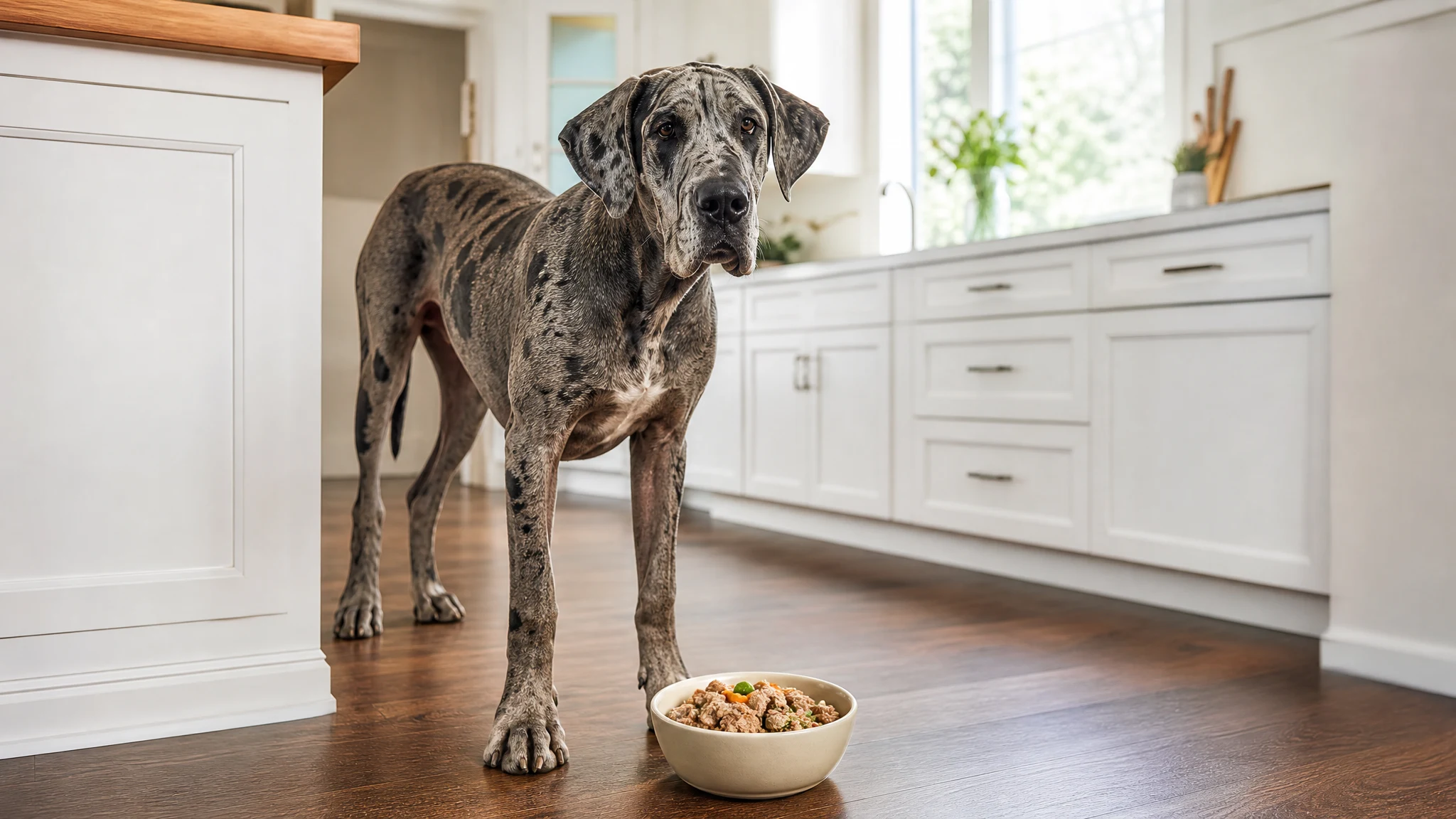
General nutrition information compiled from product labels and published sources, not veterinary advice. Your veterinarian is the right person to choose a diet for your dog, especially one with a health condition.
Choosing the best dog food for great dane puppy life is mostly a label-reading job. Marketing on the bag front says little. The small print says a lot more.
This guide walks through the steps. It then compares several growth-ready foods on label data only. We did not run feeding trials or taste tests. Everything below comes from the brands' own product pages and the sources listed at the end.
Why Great Dane puppies need a careful food choice
Great Danes are a giant breed. PetMD lists adults at an average of 110 to 175 pounds and 28 to 32 inches tall. PetMD also notes that Great Danes grow very fast and advises large-breed puppy food until about 18 months.
The Great Dane Club of America (GDCA) health page describes hypertrophic osteodystrophy (HOD) and panosteitis as painful bone conditions of rapid puppy growth. It calls HOD the more serious of the two. No food is a guaranteed safeguard against either. Your veterinarian decides what is right for your individual puppy.
What you need before you start
- The bag or can of each food you are considering, or its product page on the brand's own site
- A notepad or spreadsheet for comparing numbers
- Your puppy's current weight and age
- A list of questions for your veterinarian
- A kitchen scale or measuring cup for portions
Step 1: Find the AAFCO statement
Look for the small "nutritional adequacy" paragraph. It names a life stage: growth, maintenance, or all life stages.
Whole Dog Journal explains that growth and all-life-stages labels must say whether the food is for growth "including" or "except for" large-size dogs, meaning 70 pounds or more as an adult. A Great Dane puppy needs a statement that says "including growth of large-size dogs." An adult maintenance food does not fit a growing puppy.
Step 2: Match the food to the life stage
Check the age range the brand gives. Royal Canin lists its Giant Puppy formula for giant-breed puppies up to 8 months. Hill's lists its Large Breed Puppy recipe up to 18 months for large breeds.
Because PetMD suggests puppy food until about 18 months, ask your veterinarian when to switch. You may need to move to a different growth food after the first formula's age window ends.
Step 3: Compare protein, fat and calories
Write down the guaranteed analysis and the calories per cup. Be careful with the numbers. Some brands print guaranteed minimums. Others show averages on a dry matter basis, which are not the same thing and cannot be compared directly.
| Food (form) | AAFCO wording on the label | Protein / fat | Calories per cup | First ingredients |
|---|---|---|---|---|
| Royal Canin Giant Puppy (dry) | Growth, including large-size dogs (70 lb or more as an adult) | 32% min / 12% min | 338 kcal ME | Chicken by-product meal, brewers rice, wheat gluten, brewers rice flour, corn |
| Victor Hi-Pro Plus Large Breed Puppy (dry) | All life stages, including growth of large-size dogs | 30% min / 14% min | 365 kcal | Chicken, chicken meal, brown rice, whole grain millet, whole grain sorghum |
| Hill's Science Diet Puppy Large Breed Chicken & Brown Rice (dry) | Feeding tests substantiate complete and balanced nutrition for growing puppies | Averages of 26.7% / 15.4% dry matter (not minimums) | 387 kcal | Chicken, brown rice, whole grain oats, chicken meal, cracked pearled barley |
| Nom Nom Beef Mash (fresh) | All life stages, including growth of large-size dogs | 8% min / 5% min | 201 kcal | Ground beef, russet potatoes, eggs, carrots, peas |
| Freshpet Vital Large Breed (fresh) | All life stages | 20% min / 14% min | 337 kcal | Chicken, beef, egg, salmon, beef liver |
For a wider look across life stages, see our label-by-label comparison of dog foods for Great Danes.
Step 4: Read the statement wording on each pick
Here is what the label data supports, and what it leaves open.
Royal Canin Giant Puppy
The label says it is formulated for growth including growth of large-size dogs. It has the highest protein minimum in the table and the lowest fat minimum. The brand's page does not list a kibble size, so check the brand if size matters to you. Its age window ends at 8 months. The brand's own Giant Puppy page links to a feeding calculator.
Victor Hi-Pro Plus Large Breed Puppy
Its all-life-stages statement includes growth of large-size dogs. The brand says to feed to maintain good body condition after age one, using the chart as a guide. See the Victor product page for the full label.
Hill's Science Diet Puppy Large Breed
The statement we found says only "growing puppies." It does not include the "including growth of large-size dogs" wording in the text we reviewed. Check the bag itself or ask the brand on its product page before you rely on it for a giant breed. The brand lists it for large-breed puppies up to 18 months.
Nom Nom Beef Mash and Freshpet Vital Large Breed
Nom Nom's statement includes large-size growth. Its listed protein and fat minimums are low because it is a fresh food with high moisture, so they should not be compared directly with dry food. Freshpet's all-life-stages statement, as we found it, does not state the large-size growth wording. Confirm with the brand on its product page. Neither brand's page confirms a grain-free claim in the material we reviewed.
Step 5: Plan the meals
The GDCA health page lists bloat, also called GDV, as the number one killer of Great Danes. It says feeding multiple small meals and avoiding vigorous exercise around mealtimes may reduce risk. It also mentions a prophylactic gastropexy as an option to discuss with a vet.
Royal Canin's Great Dane adult page makes a similar point about splitting the daily ration into at least two meals. Treat the food's feeding chart as a starting point. Your veterinarian can adjust it as your puppy grows.
Step 6: Switch foods gradually
When you change foods, mix the new food into the old over several days. Watch stool and appetite. If anything looks off, call your veterinarian. Do not change foods repeatedly without a reason.
Tips
- Compare like with like. Minimums and dry matter averages are different measures.
- Write down calories per cup. Two foods with similar protein can differ a lot in calories.
- Check the brand's own page for the current label, since formulas change.
- Bring your shortlist to a vet visit and ask which one fits your puppy.
Common mistakes to avoid
- Picking a food by the front of the bag. Words like "natural" are not nutrition statements.
- Using an adult maintenance food too early. Check the life stage on the statement.
- Assuming "large breed" in the name means the AAFCO wording is there. Read the statement itself.
- Chasing a diet trend over DCM fears. The FDA's last update on its investigation is dated December 23, 2022. The FDA says no dietary cause has been established and called the issue complex. The GDCA says DCM is suspected to be inherited in the breed. Ask your veterinarian about heart screening rather than relying on a bag label.
- Treating a food as a medical fix. No food on this list prevents or treats hip dysplasia, bloat, DCM or bone disease. Only a veterinarian can prescribe a diet for a medical condition.
What to expect
A growth formula with the right AAFCO wording may help support steady, controlled growth when fed as the label directs. Many owners watch body condition, energy and stool quality over the first few weeks. Results vary by puppy, and your veterinarian is the right person to judge whether your dog is growing at a healthy rate.