Great Dane Dog Food: How to Read the Label Before You Buy
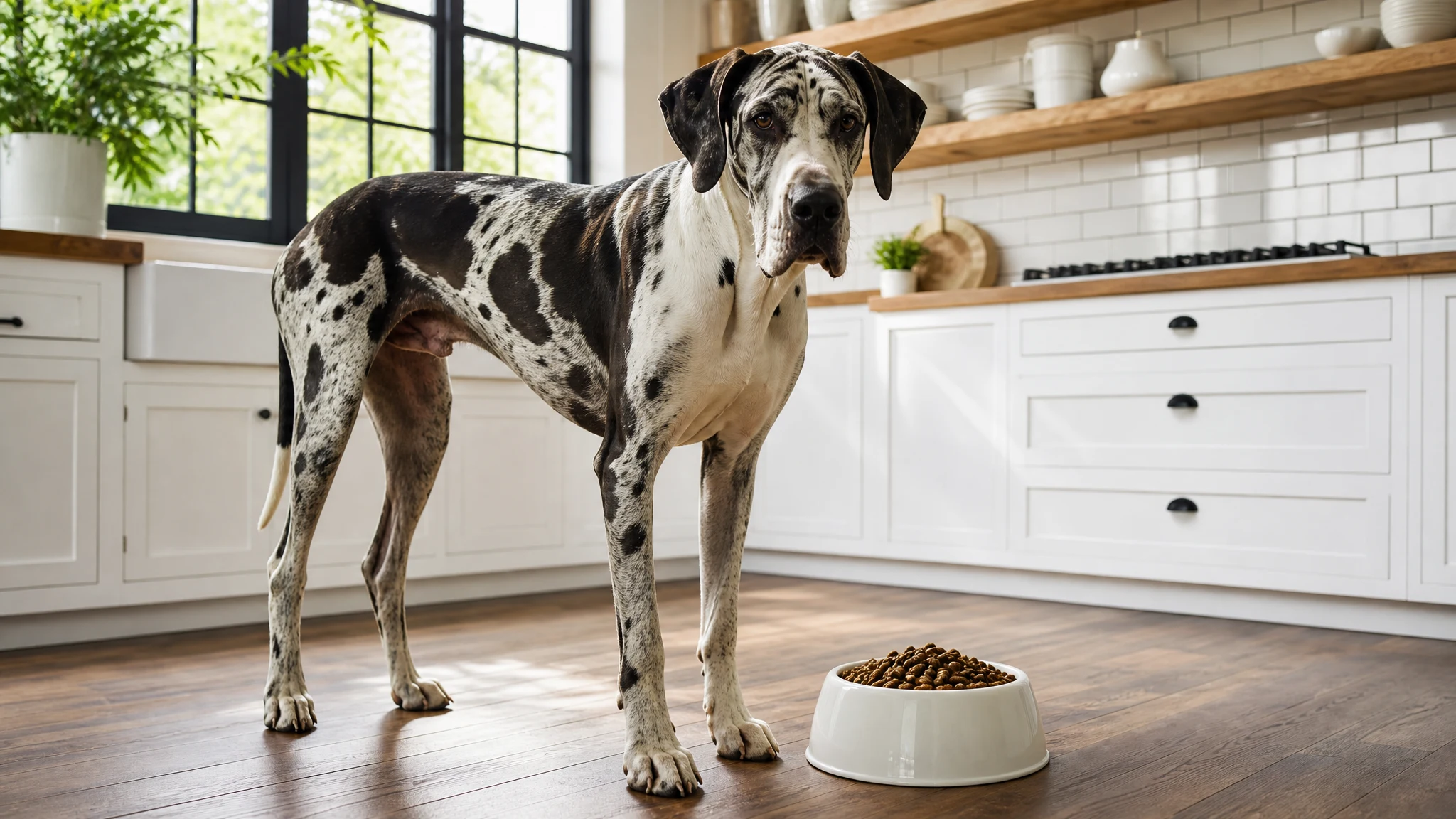
General nutrition information compiled from product labels and published sources, not veterinary advice. Your veterinarian is the right person to choose a diet for your dog, especially one with a health condition.
A Great Dane can eat a lot of food in a year, so a poor match on the label gets expensive. Front-of-bag claims do not tell you much. The small print on the back does.
This guide walks through that small print one step at a time. It uses real label data from brand pages as examples. We compared label data only. We did not run feeding trials or taste tests, and a label cannot tell you how your own dog will do.
What You Need
- The bag, or the brand's product page open on a phone or computer.
- Your dog's age and current weight. A Great Dane averages 110 to 175 pounds and 28 to 32 inches tall, according to PetMD.
- A notepad or spreadsheet to write down each food's numbers side by side.
- Any notes from your veterinarian about your dog's body condition, health history and feeding plan.
- A measuring cup, so calories per cup mean something at home.
Step 1: Find the AAFCO Nutritional Adequacy Statement
This sentence is the most useful line on the bag. It says whether the food is complete and balanced, and for which life stage. It is usually in small type near the guaranteed analysis.
For a Great Dane puppy, the wording matters. According to Whole Dog Journal, growth and all-life-stages labels must say whether the food is for growth "including" or "except for" large-size dogs, meaning 70 pounds or more as an adult. A Great Dane needs a food whose statement says it includes growth of large-size dogs.
Here is how that wording appears on a few labels:
- Royal Canin Giant Puppy states it is formulated to meet AAFCO profiles for growth including growth of large size dogs (70 lb. or more as an adult).
- Victor Hi-Pro Plus Large Breed Puppy uses the all life stages wording, also including growth of large size dogs.
- Nom Nom Beef Mash uses similar all life stages wording that includes large-size growth.
- Hill's Science Diet Puppy Large Breed Chicken & Brown Rice says feeding tests substantiate complete and balanced nutrition for growing puppies. It is made for large-breed puppies, so check the full statement on your bag.
Common mistake: assuming "all life stages" means "fine for a giant puppy." Read the rest of the sentence.
Step 2: Match the Life Stage to Your Dog
Great Danes grow very quickly. PetMD advises keeping puppies on large-breed puppy food until about 18 months. No club or vet-school source was confirmed for that exact age, so ask your veterinarian when to switch.
The Great Dane Club of America (GDCA) health page describes hypertrophic osteodystrophy (HOD) and panosteitis as painful bone conditions of rapid puppy growth. Your veterinarian is the right person to guide growth rate and food choice.
Brands set their own age ranges, so compare them to your dog:
- Royal Canin Giant Puppy is listed for giant breed puppies up to 8 months.
- Royal Canin Breed Health Nutrition Great Dane Adult is for purebred Great Danes 24 months and older.
- Hill's lists its Adult Large Breed for giant breeds 1 to 4 years, and its Adult 6+ Large Breed for giant breeds 5 and older.
A dog of 18 months can fall between a puppy food and a 24-month adult food. Ask your veterinarian how to handle that gap.
Step 3: Read the First Five Ingredients
The ingredient list starts with the heaviest ingredients. The first five give a rough picture of what the food is built on. They do not show quality on their own.
Examples of first-five lists from brand pages:
- Royal Canin Great Dane Adult: chicken fat, chicken by-product meal, tapioca, brewers rice, corn.
- Hill's Science Diet Adult Large Breed: chicken, cracked pearled barley, brown rice, brewers rice, whole grain wheat.
- Victor Hi-Pro Plus Large Breed Puppy: chicken, chicken meal, brown rice, whole grain millet, whole grain sorghum.
- Freshpet Vital Large Breed: chicken, beef, egg, salmon, beef liver.
Be skeptical of both marketing and fear. A "meal" or "by-product meal" is not automatically bad, and a fresh meat first ingredient is not automatically better. A name like "chicken" also includes water weight. Treat the list as one clue, not a verdict.
Step 4: Check the Guaranteed Analysis
The guaranteed analysis lists minimum crude protein and fat, and maximum fiber and moisture. Copy these into your notes.
- Royal Canin Great Dane Adult: protein 21% min, fat 23% min, fiber 4.2% max.
- Royal Canin Giant Puppy: protein 32% min, fat 12% min, fiber 3.9% max.
- Royal Canin Giant Adult: protein 26% min, fat 18% min, fiber 3.9% max.
- Victor Hi-Pro Plus Large Breed Puppy: protein 30% min, fat 14% min, fiber 6% max.
Common mistake: comparing a minimum to an average. Hill's product pages show average dry matter values, such as 23.8% protein for Adult Large Breed. These are not guaranteed minimums, and dry matter is not the same as as-fed. Comparing them directly to another brand's minimums would mislead you. Check the bag's own guaranteed analysis, or ask Hill's.
Wet and fresh foods hold more water, so their percentages look lower. Nom Nom Beef Mash lists 8% protein min and 5% fat min. That is not a sign of a weaker food. It is a sign you cannot compare it to kibble this way.
Step 5: Compare Calories Per Cup
Calories decide how much of a food your dog eats. A giant dog's cup count adds up fast, so a small calorie gap can matter over weeks. Here is a snapshot from brand pages:
| Food | Stated life stage | Calories |
|---|---|---|
| Royal Canin Great Dane Adult | Adult maintenance | 390 kcal ME per cup |
| Royal Canin Giant Puppy | Growth, large-size dogs included | 338 kcal ME per cup |
| Royal Canin Giant Adult | Adult maintenance | 427 kcal ME per cup |
| Hill's Adult Large Breed | Adult maintenance | 365 kcal per cup |
| Victor Hi-Pro Plus Large Breed Puppy | All life stages, large-size growth included | 365 kcal per cup |
| Freshpet Vital Large Breed | All life stages | 337 kcal per cup |
| Nom Nom Beef Mash | All life stages, large-size growth included | 201 kcal per cup |
Fresh and wet foods are far less dense per cup, so a cup is not a cup across formats. Kibble size is also worth a look. Royal Canin describes its Great Dane Adult kibble as large and textured, designed for the breed's large jaw. Several other brand pages do not state kibble size, so check with the brand.
Step 6: Treat the Feeding Guide as a Starting Point
Feeding charts are a first guess. Your dog's age, activity and body condition change the answer. Hill's says to adjust amounts as needed to maintain optimal weight, and to ask your veterinarian if unsure. Victor says to feed to maintain good body condition after age one, using its chart as a guide.
Meal pattern matters for this breed too. The GDCA health page calls bloat (GDV) the number one killer of Great Danes. It says feeding multiple small meals and avoiding vigorous exercise around mealtimes may reduce risk, and that a prophylactic gastropexy is something to discuss with a vet. Royal Canin's Great Dane Adult page also says the daily ration should be given in at least two meals to help reduce the risks of gastric dilation-volvulus.
No food can be said to prevent bloat. Use the label as a guide and let your veterinarian set the plan.
Step 7: Put Heart Disease Claims in Context
The GDCA health page says dilated cardiomyopathy (DCM) is suspected to be inherited in Great Danes. An echocardiogram confirms it, and a normal result does not guarantee it will not develop later.
The FDA's investigation page on diets and DCM has a latest update dated December 23, 2022. The agency said it does not intend to release further public updates until there is meaningful new scientific information. No dietary cause has been established, and the FDA's June 2019 update called the diet and DCM association a complex scientific issue that may involve multiple factors.
Be wary of any label or ad that says a food protects the heart. Ask your veterinarian about heart screening and diet for your individual dog.
Tips and Common Mistakes
- Write numbers down. Memory fails by the third bag.
- Compare the same format. Kibble to kibble, fresh to fresh.
- Do not mix puppy and adult rules. Check the life stage on every label.
- Do not switch foods overnight. Ask your veterinarian how to transition.
- Do not choose by a breed name alone. A "giant breed" label still needs the AAFCO statement check.
- Leave prescription diets to your veterinarian. Only a vet prescribes them.
- Check the brand's own page for missing data. Some pages do not list kibble size or minimum values. Ask the brand rather than guessing.
What to Expect
Following these steps may help you narrow a long shelf of options to a short list that fits your dog's life stage. It may also make it easier to explain your options to your veterinarian. It will not tell you how your dog will do on a food, and it does not replace a vet's advice on weight, growth or health.
For a side-by-side look at specific foods using these same label points, see our label-by-label comparison of dog food for Great Danes.
Sources
- Great Dane Club of America, Health page
- FDA CVM, Investigation into Potential Link between Certain Diets and Canine DCM
- PetMD, Great Dane breed page
- Whole Dog Journal, In the Fine Print: Nutritional Adequacy Statements
- Royal Canin, Great Dane Adult product page
- Royal Canin, Giant Puppy product page
- Royal Canin, Giant Adult product page
- Hill's Pet Nutrition, Adult Large Breed product page
- Hill's Pet Nutrition, Puppy Large Breed product page
- Victor Pet Food, Hi-Pro Plus Large Breed Puppy product page
- Freshpet, Vital Large Breed product page
- Nom Nom, Beef Mash product page