Great Dane Puppy Food: What the Label Should Say
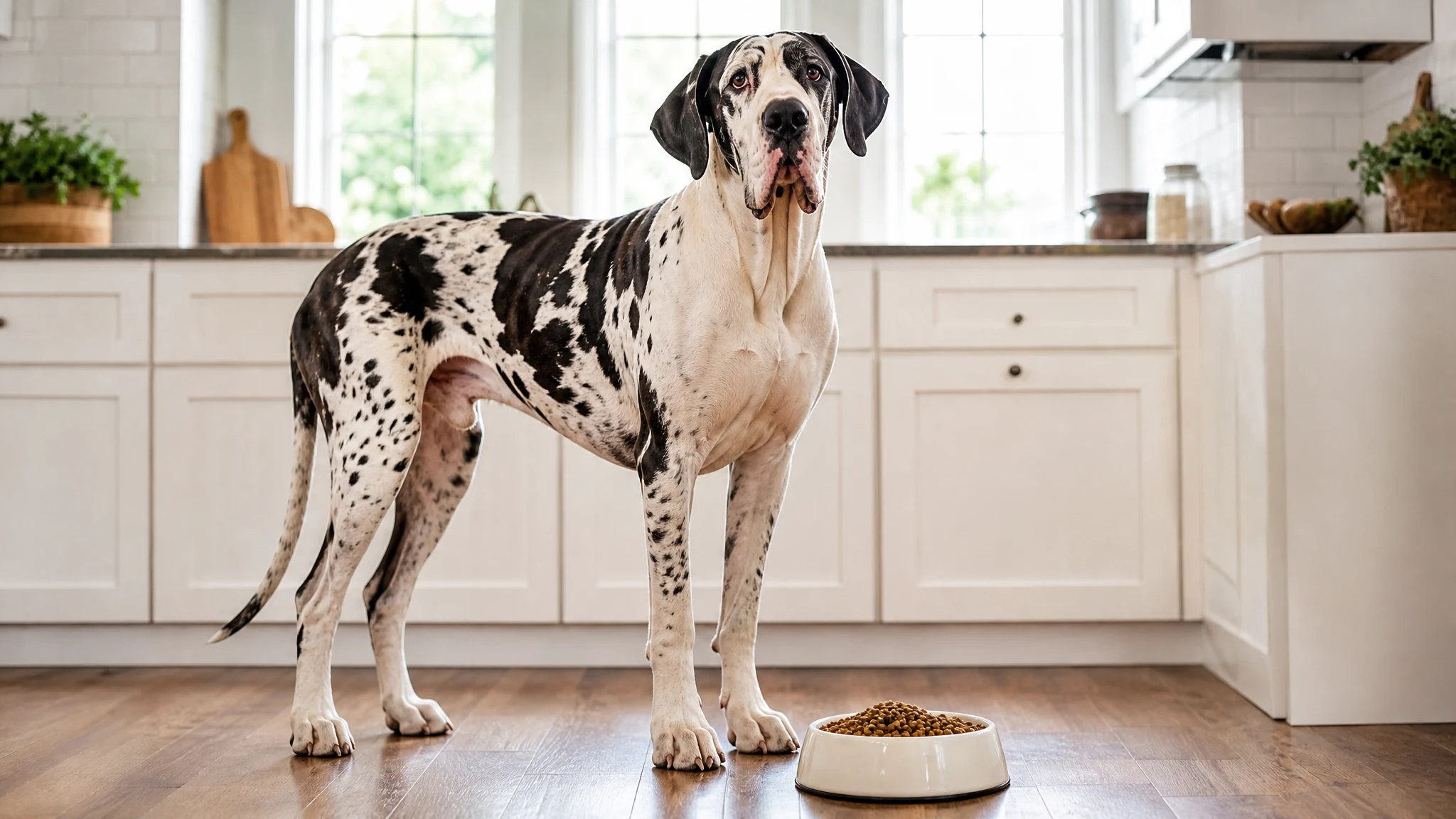
General nutrition information compiled from product labels and published sources, not veterinary advice. Your veterinarian is the right person to choose a diet for your dog, especially one with a health condition.
A Great Dane puppy grows faster than almost any other dog. Pet food bags are full of bold front-of-bag claims, but the small print on the back tells you far more. This guide shows you how to read it, one step at a time.
We compared label data from brand pages. We did not run feeding trials or taste tests, and nothing here is a recommendation for your individual dog. Your veterinarian makes that call.
What You Need Before You Start
- The bag or can you are considering, or its product page on the brand's own website
- Your puppy's age and a recent weight from your veterinarian
- A pen and paper, or a simple spreadsheet, to record each food's numbers side by side
- A list of questions for your veterinarian, especially about growth rate and body condition
Why Great Danes Need Extra Care With Puppy Food
PetMD lists the average adult Great Dane at 110 to 175 pounds and 28 to 32 inches tall, and puts the breed in the giant size category. PetMD also says Great Danes grow very fast and advises large-breed puppy food until about 18 months. That figure comes from a secondary source, so ask your veterinarian when to switch for your own dog.
The Great Dane Club of America (GDCA) health page describes hypertrophic osteodystrophy (HOD) and panosteitis as painful bone conditions of rapid puppy growth. It says HOD is the more serious and can be deadly. No food label can promise to prevent these. What a label can do is tell you whether the food was built for a large puppy at all.
Step 1: Find the AAFCO Nutritional Adequacy Statement
Look for a sentence that begins with wording like "formulated to meet the nutritional levels established by the AAFCO Dog Food Nutrient Profiles for..." It is usually in small print on the back or side. AAFCO is the Association of American Feed Control Officials, and this statement is how a food shows it is complete and balanced for a life stage.
No statement means the food may be a treat or a supplement, not a main diet. Skip it for a growing puppy.
Step 2: Check the Life Stage Wording for Large Dogs
This is the most important line for a Great Dane puppy. Whole Dog Journal, a secondary source, explains that AAFCO growth and all-life-stages labels must say whether the food is for growth "including" or "except for" large-size dogs, meaning 70 pounds or more as an adult. A Great Dane needs a statement that says it includes growth of large-size dogs.
Here is how the wording appears on a few brand pages we compared:
- Royal Canin Giant Puppy: growth "including growth of large size dogs (70 lb. or more as an adult)."
- Victor Hi-Pro Plus Large Breed Puppy: all life stages "including the growth of large size dogs (70 lb. or more as an adult)."
- Nom Nom Beef Mash: all life stages, "including growth of large size dogs (70 lb or more as an adult)."
The Hill's Science Diet Puppy Large Breed Chicken & Brown Rice Recipe states that AAFCO feeding tests substantiate complete and balanced nutrition "for growing puppies." The wording we compared does not repeat the large-size phrase. The brand says the formula is for large-breed puppies with an adult weight over 55 pounds, so ask Hill's directly how it applies to a Great Dane.
Step 3: Note the Feeding Method Behind the Statement
A statement can rest on a formulation to meet the nutrient profile or on animal feeding tests. Hill's states that its foods use AAFCO feeding tests. The Royal Canin, Victor, Freshpet and Nom Nom statements we compared say "formulated to meet." Neither method is a guarantee of how your puppy will do. It is simply one more fact to write down.
Step 4: Read the Guaranteed Analysis
The guaranteed analysis lists minimum crude protein and fat and maximum fiber. Remember that wet and fresh foods contain a lot of water, so their percentages look low next to dry kibble. Compare dry with dry, and fresh with fresh.
Hill's lists average dry matter values, not guaranteed minimums, so you cannot compare its numbers directly with other brands' minimums. Write down which kind of number you have.
Step 5: Look at Calories Per Cup
Calories tell you how much food it takes to feed the same puppy. Puppies that grow too fast on too many calories are a worry for giant breeds, so talk to your veterinarian about a target growth curve. Use the feeding guide on the bag only as a starting point.
Step 6: Scan the First Five Ingredients
Ingredients are listed by weight before cooking. The first five give you a rough picture of the recipe, but a name alone does not show quality. Treat the list as information, not a verdict. Ingredient splitting, such as several forms of rice, can also make one ingredient look smaller than it is.
Step 7: Compare the Numbers Side by Side
Here is the label data from the brand pages for foods aimed at growing large dogs. We copied what each page says and added nothing.
| Food | Large-size growth wording | Protein (min) | Fat (min) | Calories | First ingredients |
|---|---|---|---|---|---|
| Royal Canin Giant Puppy (dry) | Yes, growth including large-size dogs | 32% | 12% | 338 kcal ME per cup | Chicken by-product meal, brewers rice, wheat gluten, brewers rice flour, corn |
| Victor Hi-Pro Plus Large Breed Puppy (dry) | Yes, all life stages including large-size growth | 30% | 14% | 365 kcal per cup | Chicken, chicken meal, brown rice, whole grain millet, whole grain sorghum |
| Hill's Science Diet Puppy Large Breed (dry) | Says "growing puppies"; ask brand about large-size wording | Average 26.7% dry matter | Average 15.4% dry matter | 387 kcal per cup | Chicken, brown rice, whole grain oats, chicken meal, cracked pearled barley |
| Nom Nom Beef Mash (fresh) | Yes, all life stages including large-size growth | 8% | 5% | 201 kcal per cup | Ground beef, russet potatoes, eggs, carrots, peas |
Royal Canin lists its Giant Puppy formula for giant-breed puppies up to 8 months, and its Great Dane Adult formula is for purebred Great Danes 24 months and older. Hill's lists its large-breed puppy formula up to 18 months. The Victor page says that after age one, you should feed to maintain good body condition. The kibble size is not listed for these puppy foods, so check with each brand.
For a wider look at adult and puppy options, see our label-by-label comparison of dog foods for Great Danes.
Step 8: Use the Feeding Guide as a Starting Point
Every brand's chart is an estimate. Royal Canin's Giant Puppy page links to a feeding calculator rather than listing fixed amounts. Hill's says to adjust amounts to maintain optimal weight and to ask your veterinarian if unsure. Nom Nom says its recommendations are only a guide and vary with age, weight and activity.
Weigh your puppy regularly and share the numbers with your veterinarian, who can tell you whether the amount fits.
Step 9: Plan Meals Around Bloat Risk
The GDCA calls bloat, also called gastric dilatation-volvulus (GDV), the number one killer of Great Danes. It says feeding multiple small meals and avoiding vigorous exercise around mealtimes may reduce risk, and that a prophylactic gastropexy is an option to discuss with a veterinarian. The Royal Canin Great Dane Adult page also advises giving the daily ration in at least two meals.
Food choice alone does not settle bloat risk. Bring it up at your next vet visit.
Tips and Common Mistakes
- Mistake: trusting the front of the bag. Words like "natural" or "premium" are not the AAFCO statement. Read the back.
- Mistake: accepting "all life stages" without checking. The label must say whether it includes large-size growth. For a Great Dane puppy, look for that phrase.
- Mistake: comparing wet and dry percentages. Water content changes the numbers. Compare like with like.
- Mistake: switching foods abruptly. Ask your veterinarian how to change foods gradually.
- Mistake: switching to adult food by guesswork. PetMD suggests about 18 months, while brand pages vary. Confirm timing with your veterinarian.
- Tip: do not read a grain-free label as a safety feature. The FDA's investigation of diet and dilated cardiomyopathy (DCM) has not established a dietary cause. Its latest update, dated December 23, 2022, says the FDA does not plan more public updates until there is meaningful new scientific information. The GDCA says DCM is suspected to be inherited in the breed. Discuss heart screening with your veterinarian.
- Tip: never use supplements to "fix" a food. Ask your veterinarian before adding anything, because extra minerals can upset a balanced puppy diet.
- Tip: prescription diets are a veterinary decision. Only a veterinarian can prescribe one.
What to Expect
If you follow these steps, you may end up with a short list of foods whose labels say they are made for large-size puppy growth. You may also feel more confident reading any bag in a store. A well-matched label does not guarantee a particular result, and no food prevents or treats hip dysplasia, bloat, HOD or heart disease. The GDCA describes hip dysplasia as inherited, with multi-factorial expression.
Watch your puppy's body condition, energy and stool, and report concerns to your veterinarian. Check any product detail we could not confirm, such as kibble size, with the brand.
Quick Checklist
- Find the AAFCO statement.
- Confirm it says growth including large-size dogs.
- Note whether it uses feeding tests or formulation.
- Read protein, fat and fiber, minding dry matter versus minimums.
- Record calories per cup.
- Scan the first five ingredients.
- Treat the feeding chart as a starting point.
- Split meals and ask your veterinarian about bloat prevention.
Sources
- Great Dane Club of America, Health page
- PetMD, Great Dane breed page
- Whole Dog Journal, In the Fine Print: Nutritional Adequacy Statements
- FDA, Investigation into Potential Link between Certain Diets and Canine DCM
- Royal Canin, Giant Puppy Dry Dog Food
- Royal Canin, Great Dane Adult Dry Dog Food
- Hill's Pet Nutrition, Science Diet Puppy Large Breed
- Victor Pet Food, Hi-Pro Plus Large Breed Puppy
- Nom Nom, Beef Mash