Royal Canin Great Dane Adult Dry Dog Food: How It Compares to Other Large-Breed Formulas
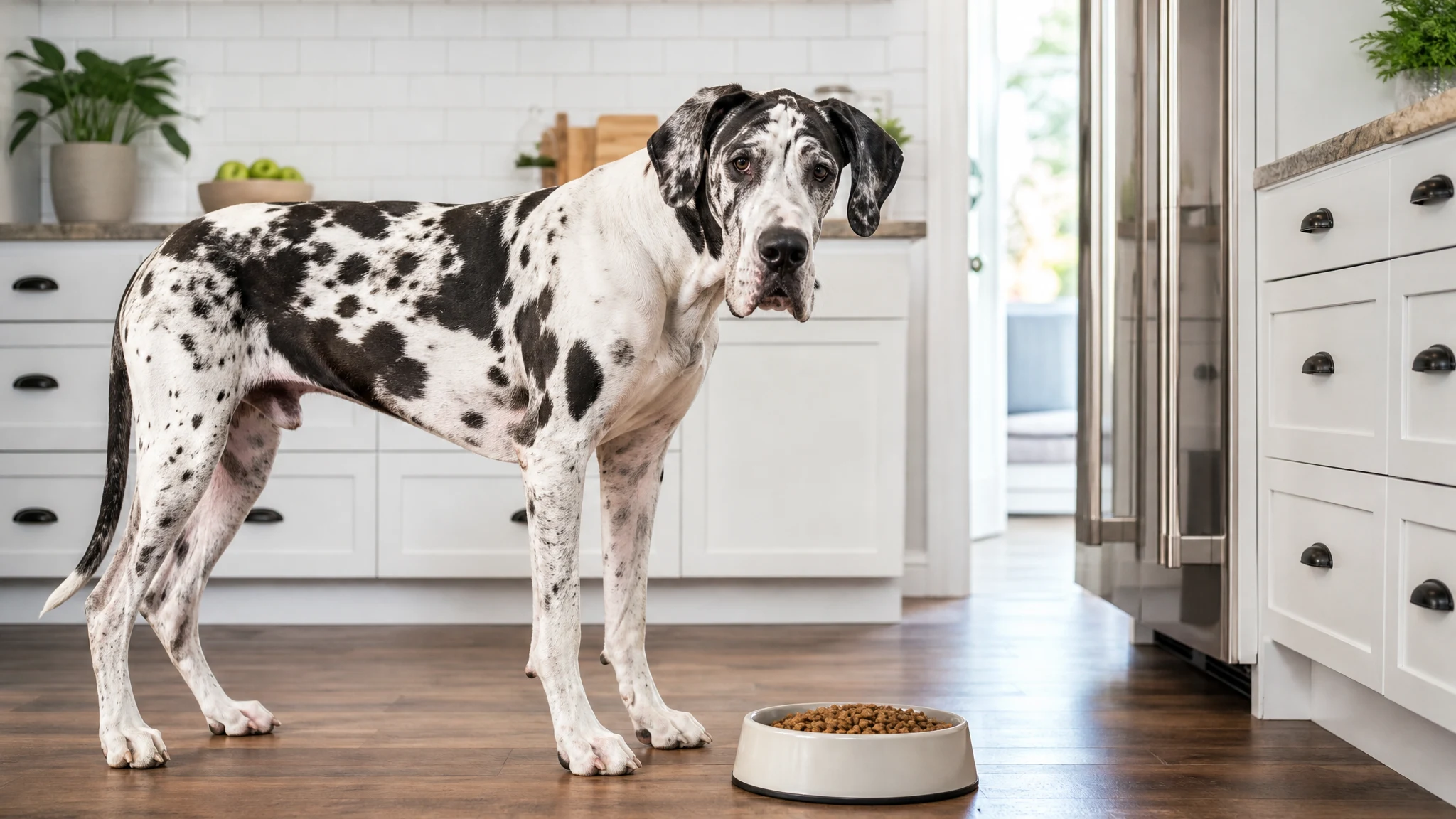
General nutrition information compiled from product labels and published sources, not veterinary advice. Your veterinarian is the right person to choose a diet for your dog, especially one with a health condition.
Reading a dog food label is a skill, and Great Dane owners need it more than most. This guide shows you how to compare Royal Canin Great Dane Adult dry dog food with other large-breed formulas, one label line at a time.
A note on method. We compared label data published on each brand's own product page. We did not run feeding trials or taste tests, and we are not saying any food is best. Your veterinarian decides what suits your individual dog.
What You Need Before You Start
- The bag or product page for each food you are weighing.
- Your dog's age and current body condition, and your vet's latest advice.
- A notepad or spreadsheet with columns for life stage, AAFCO statement, protein, fat, fiber, calories per cup and first ingredients.
- About 30 minutes.
Step 1: Match the Life Stage to Your Dog
Start with age, because it decides which foods are even candidates. PetMD, a secondary source, says Great Danes reach adulthood at about 18 months and advises large-breed puppy food until then. No club or vet-school source confirmed that exact age, so ask your vet when to switch.
Royal Canin lists its Great Dane Adult formula for purebred Great Danes 24 months and older. Its Giant Puppy formula is for giant breed puppies up to 8 months. Hill's Science Diet lists its Adult Large Breed recipe for large breeds 1 to 5 years and giant breeds 1 to 4 years. Its Adult 6+ recipe is for giant breeds 5 and up.
Notice the gaps. A young Dane between those age ranges may fall between labels, which is a good question for your vet.
Step 2: Read the AAFCO Statement Closely
The AAFCO statement tells you which life stage the food was built for. The wording matters for a giant breed.
Whole Dog Journal, a secondary source, explains that growth and all-life-stages labels must say whether the food is for growth "including" or "except for" large-size dogs, meaning 70 pounds or more as an adult. A Great Dane puppy needs the "including" version.
- Royal Canin Great Dane Adult: formulated to meet AAFCO Dog Food Nutrient Profiles for maintenance. That is an adult statement, not a growth one.
- Royal Canin Giant Puppy: meets AAFCO profiles for growth including growth of large size dogs.
- Victor Hi-Pro Plus Large Breed Puppy: meets AAFCO profiles for all life stages including growth of large size dogs.
- Hill's Science Diet Adult Large Breed: states that animal feeding tests using AAFCO procedures substantiate it for adult maintenance.
Two different methods appear here. "Formulated to meet" means the recipe matches the nutrient profile. "Feeding tests" means the maker ran an AAFCO-style trial. Both are legitimate label statements, but they are not the same claim.
Step 3: Compare Protein, Fat and Fiber the Right Way
Brands report these numbers differently, so check what each figure means before you compare.
Royal Canin and Victor list guaranteed minimums for protein and fat. Hill's pages show average dry matter values instead, which are not guaranteed minimums. Do not line those two kinds of number up as if they were equal.
| Food | Protein | Fat | Fiber | Calories per cup |
|---|---|---|---|---|
| Royal Canin Great Dane Adult | 21% min | 23% min | 4.2% max | 390 kcal ME |
| Royal Canin Giant Adult | 26% min | 18% min | 3.9% max | 427 kcal ME |
| Hill's Science Diet Adult Large Breed | 23.8% average, dry matter | 15% average, dry matter | 1.7% average, dry matter | 365 kcal |
| Hill's Science Diet Adult 6+ Large Breed | 18.7% average, dry matter | 13.5% average, dry matter | 2.4% average, dry matter | 352 kcal |
| Victor Hi-Pro Plus Large Breed Puppy | 30% min | 14% min | 6% max | 365 kcal |
What stands out is that the Royal Canin Great Dane Adult formula lists the highest fat minimum in this group at 23%, with a lower protein minimum of 21%. Royal Canin Giant Adult flips that pattern, with 26% protein and 18% fat. Neither number tells you a food is right or wrong. It tells you the recipes are built differently.
Victor's puppy formula is a different life stage, so it is shown for contrast rather than as a like-for-like adult option.
Step 4: Check Calories Per Cup and the Feeding Guide
Calories decide how much goes in the bowl. The range here runs from 352 to 427 per cup, and that is a wide spread for a dog who eats several cups a day.
Treat every feeding chart as a starting point. Hill's says to adjust amounts as necessary to maintain optimal weight and to ask your veterinarian if unsure. Royal Canin's Giant Adult page links to a feeding calculator rather than listing fixed amounts. Victor says that after age one you should feed to maintain good body condition, using the chart as a guide.
Meal pattern matters too. The Great Dane Club of America (GDCA) health page calls bloat, also called GDV, the number one killer of Great Danes. It says feeding multiple small meals and avoiding vigorous exercise around mealtimes may reduce risk, and that a prophylactic gastropexy is an option to discuss with a vet. Royal Canin's Great Dane Adult page says the daily ration should be given in at least two meals to help reduce the risks of gastric dilation-volvulus. A label note is not a promise, and no food removes this risk.
Step 5: Look at the First Five Ingredients
Ingredient lists are in order by weight, so the first five show the base of the recipe. They do not show quality on their own.
- Royal Canin Great Dane Adult: chicken fat, chicken by-product meal, tapioca, brewers rice, corn.
- Royal Canin Giant Adult: chicken by-product meal, brewers rice, chicken fat, brown rice, corn protein meal.
- Hill's Adult Large Breed: chicken, cracked pearled barley, brown rice, brewers rice, whole grain wheat.
- Victor Hi-Pro Plus Large Breed Puppy: chicken, chicken meal, brown rice, whole grain millet, whole grain sorghum.
Be skeptical of marketing language on the front of the bag. Words like "premium" or "natural" are not nutrition measures. The guaranteed analysis and the AAFCO statement are the parts to trust.
None of these four is grain-free. On the DCM question, the FDA's investigation page has a latest update dated December 23, 2022. The FDA said it does not intend to release further public updates until there is meaningful new scientific information, and that no dietary cause has been established. The GDCA health page says DCM is suspected to be inherited in the breed. Ask your vet how to think about diet for your dog.
Step 6: Consider Kibble Size and Form
Royal Canin describes the Great Dane Adult kibble as large and textured, designed for the breed's large jaw. The product pages we compared for Royal Canin Giant Adult, Hill's and Victor did not list kibble size. Check with each brand if size matters to your dog.
Fresh and wet options exist too. Freshpet Large Dog Multi-Protein Recipe lists 348 kcal per cup and an adult maintenance AAFCO statement, and its guide gives 3 1/2 cups per day for dogs 81 pounds and up, plus 3/4 cup per additional 25 pounds over 80. Hill's canned Adult Chicken & Barley is a general adult formula, not a large-breed one. These are different formats, so compare them against dry food by calories, not by cup.
Step 7: Take Your Shortlist to Your Vet
Bring your notes. Ask which AAFCO statement fits your dog's age, what body condition to aim for, and how to transition foods. A vet can weigh things a label cannot, such as your dog's weight history and any health concerns.
For a wider side-by-side look, see our label-by-label comparison of dog foods for Great Danes.
Tips for Comparing Well
- Compare foods within the same life stage first.
- Write down whether each figure is a minimum, a maximum or an average.
- Convert everything to calories per cup before judging portions.
- Use the brand's own product page for current label data, since formulas can change.
- Change foods gradually and ask your vet about the pace.
Common Mistakes to Avoid
- Treating a breed name as proof. A Great Dane formula is still just a label. Read the AAFCO statement and the numbers.
- Feeding an adult-only food to a growing puppy. A maintenance statement is not a growth statement.
- Comparing minimums to averages. Hill's dry matter averages and Royal Canin minimums are different measures.
- Following the chart blindly. Feeding guides are starting points. Watch your dog's body condition.
- Expecting a food to fix a health problem. Hip dysplasia, DCM and bloat are medical matters for your vet.
- Switching suddenly. Abrupt changes can upset a dog's stomach.
What to Expect
If you follow these steps, you should end up with a short, clear list of foods whose labels match your dog's life stage and your vet's advice. You may also find that two foods that look alike are built quite differently.
A well-matched food may support steady weight and good body condition, but results vary from dog to dog. Label comparison cannot predict how your dog will do, so keep checking in with your veterinarian as your Dane grows and ages. PetMD lists a typical life expectancy of 7 to 10 years for the breed, which is one more reason to make these decisions carefully.
Sources
- Royal Canin US: Breed Health Nutrition Great Dane Adult
- Royal Canin US: Giant Adult
- Royal Canin US: Giant Puppy
- Hill's Pet Nutrition: Science Diet Adult Large Breed
- Hill's Pet Nutrition: Science Diet Adult 6+ Large Breed
- Victor Pet Food: Hi-Pro Plus Large Breed Puppy
- Freshpet: Large Dog Multi-Protein Recipe
- Great Dane Club of America: Health
- PetMD: Great Dane breed page
- Whole Dog Journal: In the Fine Print, Nutritional Adequacy Statements
- FDA CVM: Investigation into Potential Link between Certain Diets and Canine DCM