Royal Canin Great Dane Adult Dry Dog Food: What the Label Shows
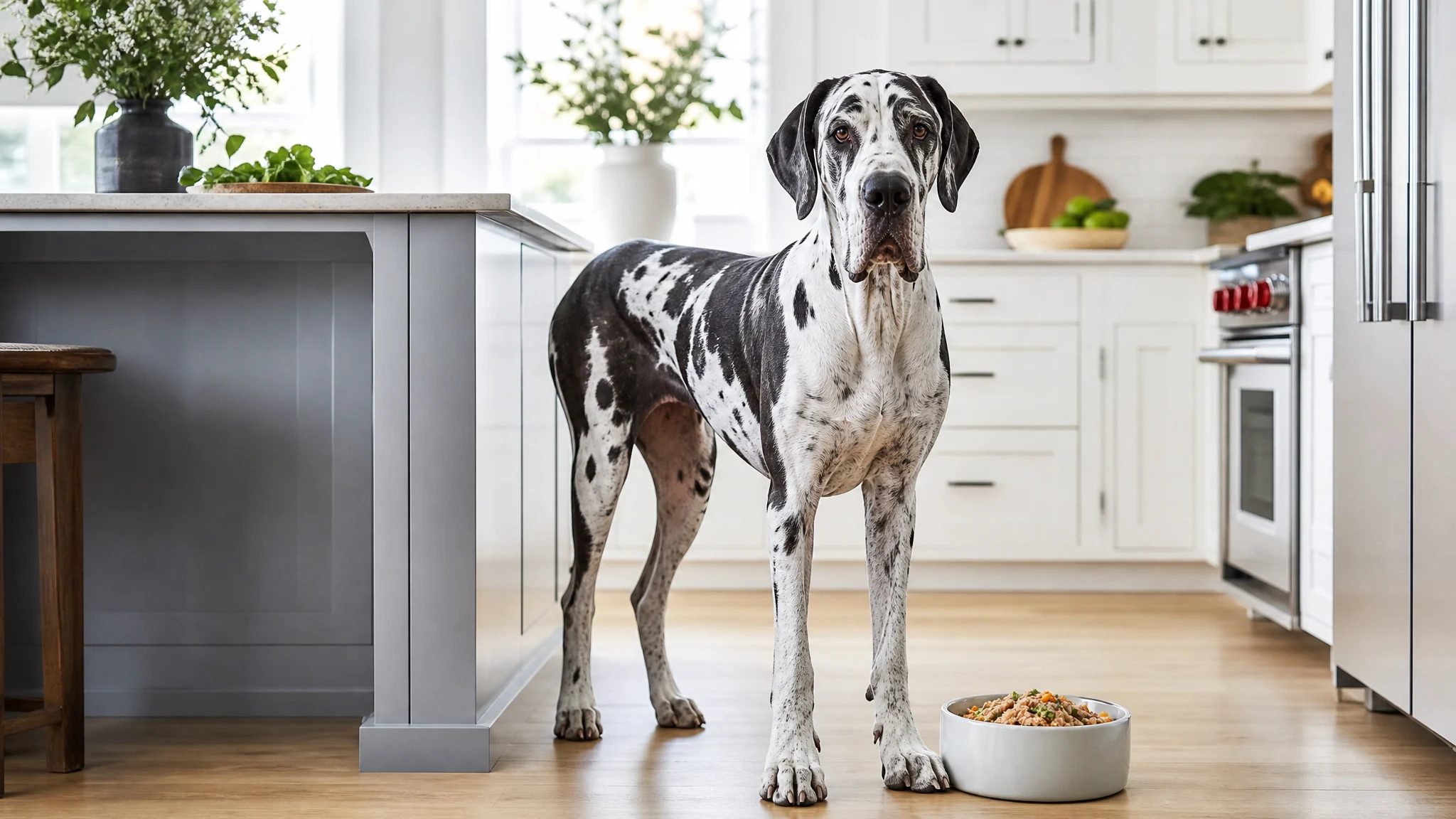
General nutrition information compiled from product labels and published sources, not veterinary advice. Your veterinarian is the right person to choose a diet for your dog, especially one with a health condition.
Great Dane owners often hear that a breed-specific bag is the safe choice. A label is a better place to start than a slogan. This guide walks you through reading the label of Royal Canin Breed Health Nutrition Great Dane Adult dry dog food, one line at a time.
We compared label data from the brand's own product page. We did not run feeding trials or taste tests, and we are not telling you this food is right for your dog. Your veterinarian makes that call for an individual dog.
What you need before you start
- The bag, or the Royal Canin product page for the Great Dane Adult formula.
- Your dog's age, current weight and body condition notes from your veterinarian.
- A notepad or phone to write down numbers.
- The labels of any other food you are comparing.
- A standard measuring cup, so you know how much a "cup" really holds.
Step 1: Check the life stage first
Royal Canin lists this formula for purebred Great Danes 24 months and older. That is a label statement about the intended dog, not a medical rule.
PetMD, a secondary source, says a Great Dane is considered adult at about 18 months and advises large-breed puppy food until then. The two sources differ by several months. If your dog is between 18 and 24 months, ask your veterinarian when to switch. Giant breeds grow fast, so timing matters.
Common mistake: moving a young dog to an adult bag because the dog already looks full-grown. Height and weight can run ahead of the age the label expects.
Step 2: Find the AAFCO statement
Look for a sentence naming the AAFCO Dog Food Nutrient Profiles. This is the line that says what the food is built for.
For this product, the statement says it is formulated to meet the AAFCO Dog Food Nutrient Profiles for maintenance. That means adult upkeep, not growth.
This matters for a breed that grows so quickly. Whole Dog Journal, a secondary source, explains that growth and all-life-stages labels must say whether they cover growth "including" or "except for" large-size dogs, meaning 70 pounds or more as an adult. A Great Dane puppy needs the "including" wording. An adult maintenance statement like this one is the right type for an adult, and it is not a puppy food.
Tip: the same brand's Giant Puppy formula carries the "growth including growth of large size dogs" wording on its label. Royal Canin's page lists it for giant-breed puppies up to 8 months, so ask your veterinarian what comes next.
Step 3: Read the first five ingredients
Ingredients are listed by weight before cooking. The first five on this label are:
- Chicken fat
- Chicken by-product meal
- Tapioca
- Brewers rice
- Corn
Read this list calmly. Chicken fat and by-product meal are the first two items, and the next three are starch sources. The formula is not grain free, since it contains brewers rice and corn.
Marketing often treats "by-product" or "corn" as red flags, and we would rather you not take that shortcut. The label tells you what is in the bag. It does not tell you how a particular dog will do on it.
If you have heard about diet and dilated cardiomyopathy (DCM), the FDA's investigation page says no dietary cause has been established. It calls the diet and DCM link a complex scientific issue that may involve multiple factors. The FDA's latest update on that page is dated December 23, 2022, and it said it did not plan more public updates without meaningful new scientific information.
The Great Dane Club of America notes that DCM is suspected to be inherited in the breed, and that an echocardiogram confirms the disease. Questions about heart health belong with your veterinarian, not on a food label.
Step 4: Note the guaranteed analysis
Write down the numbers the brand publishes for this formula:
| Item | Label figure |
|---|---|
| Crude protein | 21.0% minimum |
| Crude fat | 23.0% minimum |
| Crude fiber | 4.2% maximum |
| Energy | 390 kcal ME per cup (as fed, calculated) |
Fat at 23.0% minimum is on the high side for a dry food, and it shows up in the calorie figure. Protein at 21.0% minimum is modest.
These are as-fed numbers. The page figures we have do not include moisture, so we have not converted them to a dry-matter basis. If you compare this to another food, compare as-fed to as-fed, or ask the brand for dry-matter values.
Step 5: Compare calories per cup, not just the bag size
Calories decide how much your dog eats, and a giant dog eats a lot. Here is how this formula sits next to two other Royal Canin giant-dog labels, using the brand's own pages:
| Formula | Statement type | Protein min | Fat min | kcal ME per cup |
|---|---|---|---|---|
| Great Dane Adult | Maintenance | 21.0% | 23.0% | 390 |
| Giant Adult | Maintenance | 26.0% | 18.0% | 427 |
| Giant Puppy | Growth, including large-size dogs | 32.0% | 12.0% | 338 |
The three labels differ a good deal in protein, fat and energy. The numbers alone do not tell you which one a dog should eat, but they show why you should not swap formulas by cup alone. A cup of one is not a cup of another.
For a wider look at other brands on the same terms, see our label-by-label comparison of dog foods for Great Danes.
Step 6: Look at kibble design and the feeding note
Royal Canin describes the kibble as large and textured, designed for the Great Dane's large jaw. That is the brand's description. We have not seen how any particular dog handles it.
The feeding note on the page says the daily ration should be given in at least two meals to help reduce the risks of gastric dilation-volvulus (GDV, or bloat). The Great Dane Club of America's health page also says feeding multiple small meals and avoiding vigorous exercise around mealtimes may reduce risk. It calls bloat the number one killer of Great Danes, and says a prophylactic gastropexy is something to discuss with a veterinarian.
No food or meal plan removes that risk. Use the label's meal advice as one piece of a conversation with your vet.
Step 7: Treat the feeding chart as a starting point
Use the brand's feeding guide for the starting amount, then adjust with your veterinarian based on body condition. We are not printing amounts here, so check the bag or the Royal Canin page for the current guide.
Weigh or level your measuring cup the same way each time. With 390 kcal in a cup, a heaping scoop adds up quickly in a dog this size.
Step 8: Switch foods slowly, if you switch at all
If your veterinarian agrees this formula fits, ask for their transition plan. A common approach is to mix the new food into the old over several days. Follow your vet's schedule rather than ours.
Common mistakes to avoid
- Assuming "breed formula" means "best." It means the brand designed it for the breed. It is not a finding that it suits every Dane.
- Ignoring the life stage line. Puppies need a growth statement that covers large-size dogs.
- Comparing percentages across wet and dry foods. Moisture changes the numbers.
- Treating a food as a treatment. Hip dysplasia, bone conditions in growing puppies, DCM and bloat are medical matters. The Great Dane Club of America describes them on its health page, and a veterinarian guides care.
- Counting only the bowl. Treats and table scraps add calories too.
What to expect
Reading the label will not tell you how your dog will respond. What it can do is help you ask better questions.
If your veterinarian agrees the food suits your dog, you may notice steady stools, a stable body weight and normal energy over the following weeks. These are things to watch for, and they may not happen for every dog. Report any vomiting, loose stool, weight change or belly swelling to your veterinarian promptly. A swollen, tight belly with retching can be an emergency in this breed.
The Great Dane lifespan is 7 to 10 years according to PetMD, so adult nutrition decisions usually span a good part of your dog's life. A short chat with your veterinarian once or twice a year is time well spent.
Quick checklist
- Confirm your dog's age fits the 24-month adult label.
- Find the AAFCO maintenance statement.
- Read the first five ingredients without panic or hype.
- Write down protein, fat, fiber and 390 kcal per cup.
- Compare with other labels as-fed to as-fed.
- Plan at least two meals a day, as the label advises.
- Take your notes to your veterinarian.
Sources
- Royal Canin US product page, Breed Health Nutrition Great Dane Adult
- Royal Canin US product page, Giant Adult
- Royal Canin US product page, Giant Puppy
- Great Dane Club of America, Health page
- PetMD, Great Dane breed page
- Whole Dog Journal, In the Fine Print: Nutritional Adequacy Statements
- FDA CVM, Investigation into Potential Link between Certain Diets and Canine DCM