Wet vs Dry vs Fresh Food for Great Danes
General nutrition information compiled from product labels and published sources, not veterinary advice. Your veterinarian is the right person to choose a diet for your dog, especially one with a health condition.
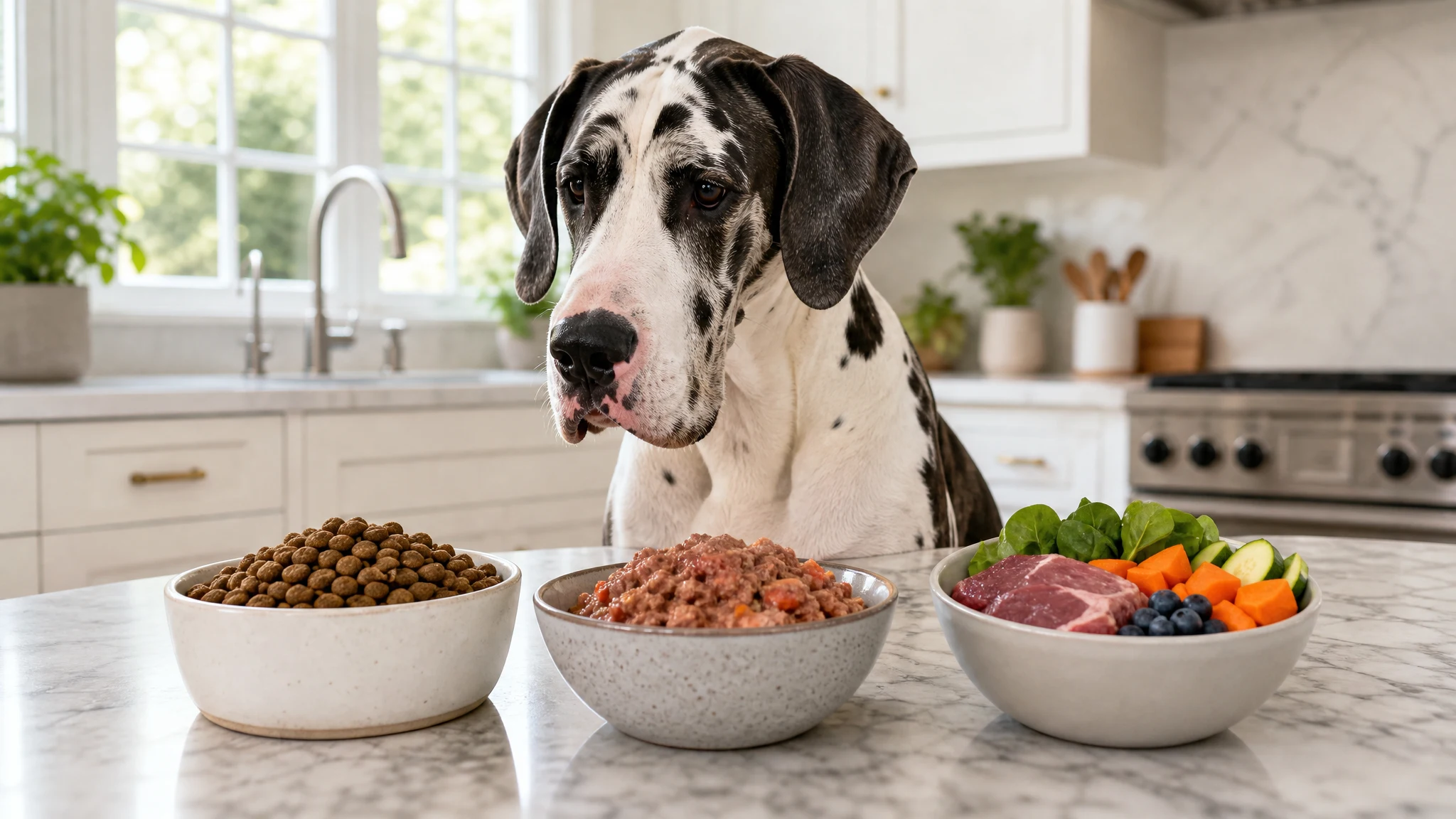
Walk down any pet food aisle and the same question comes up: wet vs dry dog food, and now fresh too. For a Great Dane, the answer is less about the form and more about the label. A food has to be complete and balanced for your dog's life stage, and it has to be one you can feed in the amounts a giant dog needs.
This article compares the three forms using label data from the brands' own product pages. We did not run feeding trials or taste tests. We read labels and lined them up. A veterinarian decides what is right for an individual dog.
First, what matters for the breed
PetMD lists the average adult Great Dane at 110 to 175 pounds and 28 to 32 inches tall, and puts life expectancy at 7 to 10 years. PetMD also advises keeping puppies on large-breed puppy food until about 18 months. That is a secondary source, so ask your veterinarian about the timing for your own dog.
Three breed points shape this comparison.
- Bloat. The Great Dane Club of America (GDCA) health page calls bloat (GDV) the number one killer of Great Danes. It says feeding multiple small meals and avoiding vigorous exercise around mealtimes may reduce risk. A prophylactic gastropexy is an option to discuss with a vet.
- Fast growth. PetMD, quoting the GDCA, says Great Danes grow very fast and that large-breed puppy food is advised. The GDCA describes HOD and panosteitis as painful bone conditions of rapid puppy growth.
- Heart disease. The GDCA says dilated cardiomyopathy (DCM) is suspected to be inherited in the breed.
None of the three food forms is shown to prevent or treat any of these. Form is a practical choice. The nutrition statement on the bag, can or tray matters more.
The label check that applies to every form
According to Whole Dog Journal (a secondary source), AAFCO growth and all-life-stages labels must say whether the food is for growth "including" or "except for" large-size dogs, meaning 70 pounds or more as an adult. A Great Dane puppy needs a statement that says "including growth of large-size dogs."
This applies to wet, dry and fresh foods alike. Of the products we compared, these carry that wording on the brand's page:
- Royal Canin Giant Puppy (dry)
- Victor Hi-Pro Plus Large Breed Puppy (dry, all life stages)
- Nom Nom Beef Mash (fresh, all life stages)
The Freshpet Vital Large Breed recipe is labeled for "all life stages," but the statement we have does not include the large-size growth wording. If you are shopping for a puppy, check with Freshpet before assuming it fits. The canned Hill's Science Diet product we looked at is an adult maintenance food, so it is not a puppy option.
Side-by-side comparison
| Attribute | Dry | Wet (canned) | Fresh |
|---|---|---|---|
| Examples from the label data | Royal Canin Great Dane Adult, Royal Canin Giant Puppy, Royal Canin Giant Adult, Hill's Science Diet Large Breed, Victor Hi-Pro Plus | Hill's Science Diet Adult Chicken & Barley Entree (canned) | Freshpet Vital Large Breed, Freshpet Large Dog Multi-Protein, Nom Nom Beef Mash |
| Moisture | Low. The first ingredient is usually a meat or meal. | High. Water is the first listed ingredient on the Hill's can. | High. Ingredients lead with whole meats, eggs or potatoes. |
| Calories | 338 to 427 kcal per cup across the dry foods compared | 369 kcal per 13 oz can (per can, not per cup) | 337 and 348 kcal per cup for the two Freshpet recipes; 201 kcal per cup for Nom Nom Beef Mash |
| Cost per day (general terms) | Often the lowest per day for a giant dog, but check each brand's current pricing | Usually higher, because several cans a day may be needed | Usually higher still, because of the volume and the packaging |
| Storage and handling | Easiest to store and measure | Opened cans need refrigeration | Refrigerated product, so it takes fridge space |
| Breed-specific options | Yes. Royal Canin makes a Great Dane Adult formula and giant-breed formulas. | None in the label data; the Hill's can is a general adult formula | Large-breed or large-dog recipes; none is Great Dane specific |
| Large-size growth wording | Yes, for Royal Canin Giant Puppy and Victor Hi-Pro Plus | No; adult maintenance only | Nom Nom yes; Freshpet Vital Large Breed not stated in the statement we have |
The calorie figures come from each brand's page. Some are "as fed, calculated" and some are listed per kilogram or per pound. Treat them as labels, not measurements.
Dry food
Pros
- The widest range of breed-fitted choices. Royal Canin lists a Great Dane Adult formula for purebred Great Danes 24 months and older. Its kibble is described as large and textured, designed for the Great Dane's large jaw. Royal Canin also makes Giant Puppy and Giant Adult dry foods.
- Calorie density per cup. The Royal Canin Giant Adult lists 427 kcal per cup, and the Hill's Large Breed adult lists 365. A dog this size eats a lot, and a denser food keeps the volume down.
- Easy to measure and split into meals. That helps with the multiple-small-meals advice from the GDCA. Royal Canin's Great Dane page says the daily ration should be given in at least two meals to help reduce the risks of gastric dilation-volvulus.
- Lower cost per day in general. Compare current prices on the brand's own site.
Cons
- Low moisture, so water intake comes from the bowl.
- Kibble size is only stated for one product. For the Royal Canin Giant Puppy, Giant Adult, Hill's and Victor foods, the label data we have does not give kibble size. Check with the brand.
- Some dry foods are very calorie dense, so measuring matters for weight control.
Wet food
Pros
- High moisture. Water is the first ingredient on the Hill's Science Diet Adult Chicken & Barley Entree.
- Different texture. It can suit a dog that is slow to eat or off dry food. Ask your veterinarian if appetite changes suddenly.
- Complete and balanced. Hill's states that animal feeding tests using AAFCO procedures substantiate adult maintenance.
Cons
- The feeding math is large. The Hill's can is 369 kcal per 13 oz can. Its feeding chart runs to 120 lb dogs at 6 cans per day, and many Great Danes are heavier than that. Check with Hill's or your veterinarian for dogs above the chart.
- No breed-specific wet option in the label data we compared. The Hill's can is a general adult formula.
- Cost per day is typically higher for a giant dog, because of how many cans are needed.
- Not for puppies in this case, since the product is labeled for adult maintenance.
If you are weighing wet food for Great Danes, think of it as an option that works best in small amounts rather than as the whole diet. See the mixing section below.
Fresh food
Pros
- Whole-food ingredient lists. The Freshpet recipes list chicken, beef, egg and salmon first. Nom Nom Beef Mash lists ground beef, russet potatoes, eggs, carrots and peas.
- Large-dog feeding guidance. For Freshpet Large Dog Multi-Protein, the brand lists 3 1/2 cups per day for dogs 81 lbs and up, plus 3/4 cup for each additional 25 lbs over 80. Freshpet says it can be fed as one meal or divided into two. Treat that as a starting point.
- Nom Nom covers large-size growth. Its statement says all life stages, including growth of large size dogs.
Cons
- Cost and storage. This is usually the most expensive form for a giant dog. We have no prices to quote, so check each brand.
- Lower calories per cup in some cases. Nom Nom Beef Mash lists 201 kcal per cup, so a Great Dane would need a large volume. Nom Nom's page gives only a general guide that varies with age, weight and activity, so ask the brand or your veterinarian about amounts.
- Unknowns. The grain-free status of the Freshpet and Nom Nom recipes is not confirmed in the label data we have. Check the brand.
- No Great Dane specific recipe in this group.
People searching for fresh dog food for Great Danes often ask whether it is healthier. The label data cannot answer that. It shows what is in the food and the calories, and nothing about health outcomes.
Moisture and calories: a fair way to compare
Wet and fresh foods contain more water, so the protein and fat numbers on their labels look small next to dry food. Nom Nom Beef Mash lists a minimum of 8 percent protein and 5 percent fat. Royal Canin Giant Adult lists 26 and 18. These are not comparable on an "as fed" basis.
Compare calories per day instead, then check that the food meets the right AAFCO statement. Hill's lists averages on a dry matter basis for its foods, and those are not guaranteed minimums, so don't set them beside another brand's guaranteed minimums.
The dental myth
A common belief is that dry kibble cleans teeth and wet food ruins them. The label data we compared does not support either claim. An AAFCO statement is about nutrient adequacy and says nothing about dental health. If you are worried about your dog's teeth, ask your veterinarian about dental exams and care.
Can you mix wet, dry and fresh?
Mixing is common, and nothing in the label data says it is wrong. A few cautions help:
- Count total calories. A topper adds calories, so reduce the base food to match.
- Keep the main food complete and balanced for the dog's life stage. For a puppy, that means a large-size growth statement.
- Keep meals split. The GDCA's advice about multiple small meals still applies.
- Do not change foods suddenly. Ask your veterinarian how to transition.
Mixing can also be a way to use a small amount of a pricier food. Ask your veterinarian before adding food to a puppy's diet, because the GDCA notes puppy growth can be a risk period for bone conditions.
Best for: use cases
- Great Dane puppy: Look for a dry or fresh food with a "growth including large-size dogs" statement. Royal Canin Giant Puppy, Victor Hi-Pro Plus and Nom Nom Beef Mash are the ones in this comparison that carry that wording. Confirm the details with the brand and your veterinarian.
- Adult on a budget or a heavy eater: Dry food, since it is usually the lowest cost per day and the most calorie dense.
- Adult who needs a breed-fitted kibble: Royal Canin Great Dane Adult, which lists a large, textured kibble made for the breed's large jaw.
- Picky eater or a dog that likes moisture: Wet or fresh as a topper, with the base food reduced to match.
- Senior: Hill's Science Diet Adult 6+ Large Breed lists giant breeds 5+ years. Ask your veterinarian what suits an older dog.
- Dog with a medical condition: A veterinarian decides. Prescription diets are only something a veterinarian prescribes.
The verdict
For most Great Danes, a complete and balanced dry food is the practical base. It has the widest set of breed-fitted choices, the highest calories per cup and, in general, the lowest daily cost. Wet and fresh foods work well as additions, or as the main food if your budget and fridge allow. Each of them needs the same label checks as dry food.
The things that decide the choice are the AAFCO statement for your dog's life stage, the daily calories, and whether you can split the day's food into at least two meals. The form is secondary. Nothing in the label data says one form protects against bloat, DCM, hip dysplasia or bone disease.
For a deeper look at individual products, see our label-by-label comparison of dog foods for Great Danes.
On DCM, the FDA's last update on its investigation is dated December 23, 2022. The FDA said it does not intend to release further public updates until there is meaningful new scientific information, and that no dietary cause has been established. Discuss any concern with your veterinarian.
Sources
- Great Dane Club of America, Health page
- PetMD, Great Dane breed page
- Whole Dog Journal, In the Fine Print: Nutritional Adequacy Statements
- FDA CVM, Investigation into Potential Link between Certain Diets and Canine DCM
- Royal Canin, Great Dane Adult
- Royal Canin, Giant Puppy
- Royal Canin, Giant Adult
- Hill's Science Diet, Adult Chicken & Barley Entree (canned)
- Victor, Hi-Pro Plus Large Breed Puppy
- Freshpet, Large Dog Multi-Protein Recipe
- Nom Nom, Beef Mash