How Much to Feed a Great Dane: Feeding Chart by Age and Weight
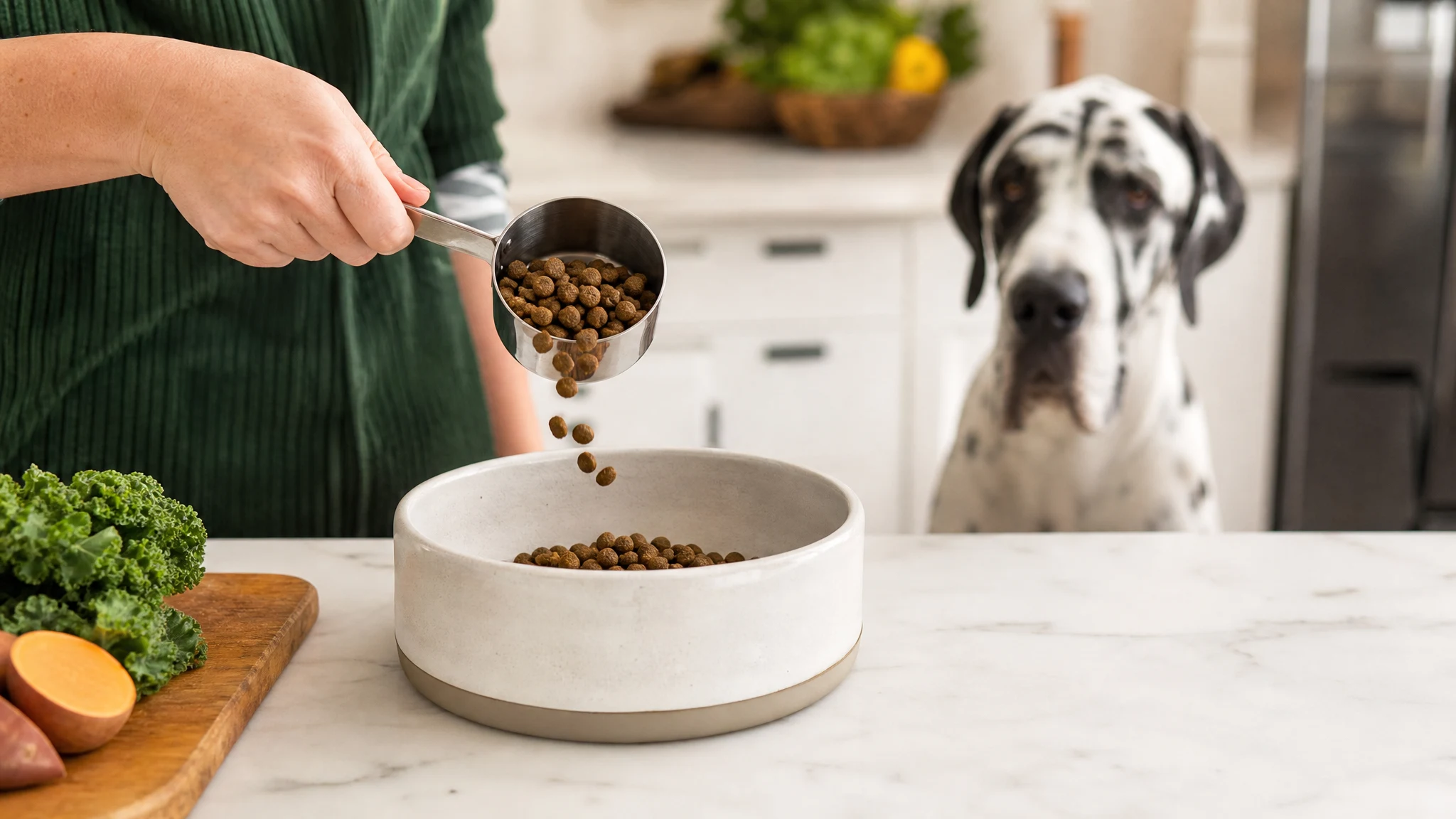
General nutrition information compiled from product labels and published sources, not veterinary advice. Your veterinarian is the right person to choose a diet for your dog, especially one with a health condition.
Most owners ask how much to feed a Great Dane before they ask which food to buy. It is a fair order. A giant dog can gain or lose weight quickly, and the amount in the bowl matters as much as the brand.
There is no single number that fits every dog. This guide shows a method: read the label, work out calories, split meals sensibly, then adjust by body condition. It includes a Great Dane feeding chart built from real label data, with the limits of that chart stated plainly.
One note on method. We compared label data from the brands' own pages. We did not run feeding trials or taste tests. Everything below is a starting point, and a veterinarian sets the amount for an individual dog.
What a Great Dane's size means for feeding
PetMD, a secondary source, lists the average adult Great Dane at 110 to 175 pounds and 28 to 32 inches tall, and puts the breed in the giant category. It gives a life expectancy of 7 to 10 years. That range of 65 pounds is why a single cup measure printed on a bag rarely fits every Dane.
PetMD also says Great Danes reach adulthood at about 18 months and advises large-breed puppy food until then. Royal Canin's Great Dane adult formula is labeled for purebred Danes 24 months and older. Ask your veterinarian when to move your own dog to an adult food.
Two health topics from the Great Dane Club of America (GDCA) Health page shape how we feed:
- Bloat (GDV). The GDCA calls it the number one killer of Great Danes. It says feeding multiple small meals and avoiding vigorous exercise around mealtimes may reduce risk. It also lists prophylactic gastropexy as an option to discuss with a vet.
- Rapid puppy growth. The GDCA describes HOD and panosteitis as painful bone conditions of fast growth, with HOD the more serious. Overfeeding a puppy is not a safe shortcut to a big dog.
No food is claimed to prevent or treat any of these. Diet is one part of the picture, and your veterinarian decides what fits your dog.
What you need
- The bag, can or tray label for the food you actually feed, including the feeding guide and the calorie statement.
- A standard dry measuring cup, or better, a kitchen scale for weighing portions.
- A recent weight for your dog, usually taken on a scale at your veterinarian's office.
- A notebook or phone note to record amounts, treats and weekly body checks.
- Your veterinarian's contact details, since they set the final amount.
Step 1: Choose a food with the right life-stage statement
Start with the AAFCO nutritional adequacy statement on the label. Whole Dog Journal, a secondary source, explains that growth and all-life-stages foods must say whether they cover growth "including" or "except for" large-size dogs (70 pounds or more as an adult). A Great Dane puppy needs a food whose statement says it includes growth of large-size dogs.
Some labels we compared show this wording. Royal Canin Giant Puppy and Victor Hi-Pro Plus Large Breed Puppy both state growth including large-size dogs. Nom Nom Beef Mash says the same for all life stages. The Hill's large breed puppy label states complete and balanced nutrition for growing puppies, so ask your vet how it fits a Dane.
Adult foods in the comparison state maintenance. Check the statement on your own bag, since formulas change.
Step 2: Read the label's feeding guide and calories
Every label gives a feeding guide and a calorie figure. Calories per cup differ a lot between foods, so one cup of one food is not one cup of another. These are the figures on the brands' own pages.
| Food (label source) | Form and stage | Calories on label |
|---|---|---|
| Royal Canin Great Dane Adult | Dry, purebred Danes 24 months and older | 390 kcal ME per cup (calculated) |
| Royal Canin Giant Puppy | Dry, giant puppies up to 8 months | 338 kcal ME per cup (calculated) |
| Royal Canin Giant Adult | Dry, giant adults | 427 kcal ME per cup (calculated) |
| Hill's Science Diet Puppy Large Breed | Dry, large puppies up to 18 months | 387 kcal per cup |
| Hill's Science Diet Adult Large Breed | Dry, adult | 365 kcal per cup |
| Victor Hi-Pro Plus Large Breed Puppy | Dry, all life stages incl. large-dog growth | 365 kcal per cup |
| Freshpet Large Dog Multi-Protein | Fresh, adult | 348 kcal per cup |
| Nom Nom Beef Mash | Fresh, all life stages incl. large-dog growth | 201 kcal per cup |
Compare Royal Canin's two adult dry foods. Giant Adult lists 427 kcal per cup and Great Dane Adult lists 390. That is about 9 percent more energy per cup, so swapping one for the other cup for cup would change what your dog eats.
Step 3: Build your Great Dane feeding chart
Brands publish feeding guides in different formats, and not every guide reaches Great Dane weights. This chart shows what each label says. Where a label gives no fixed amounts, we say so rather than guess.
| Stage and weight | Food and label source | What the label guide says |
|---|---|---|
| Giant puppy, up to 8 months | Royal Canin Giant Puppy | The page links to a feeding calculator and lists no fixed amounts. Use the calculator and your vet's advice. |
| Large-breed puppy, up to 18 months | Hill's Science Diet Puppy Large Breed | Adjust feeding amounts as necessary to maintain optimal weight. If unsure, ask your veterinarian. |
| Puppy over age one | Victor Hi-Pro Plus Large Breed Puppy | After age one, feed to maintain good body condition, using the feeding chart as a guide. |
| Adult Great Dane, any weight | Royal Canin Great Dane Adult | Give the daily ration in at least two meals to help reduce the risk of gastric dilation-volvulus. No fixed cup amounts are listed on the page we used. |
| Adult giant breed | Royal Canin Giant Adult | The page links to a feeding calculator and lists no fixed amounts. |
| Adult, about 105 lb | Freshpet Large Dog Multi-Protein | The label says 3 1/2 cups a day for 81+ lb, plus 3/4 cup per additional 25 lb over 80. That works out to 4 1/4 cups, or roughly 1,480 kcal at 348 kcal per cup. |
| Adult, about 130 lb | Freshpet Large Dog Multi-Protein | Using the same label rule, 5 cups a day, or roughly 1,740 kcal. The label allows one meal or two, but for a Dane, ask your vet about splitting it. |
| Adult, up to 120 lb | Hill's Science Diet Adult Chicken & Barley canned | The chart runs to 120 lb dogs at 6 cans a day, at 369 kcal per 13 oz can. This is a general adult formula, not a Great Dane one, and the chart stops short of the heaviest Danes. |
The calorie totals above are our own arithmetic from the label figures, rounded. They show how the numbers connect. They are not a recommendation for your dog.
Notice the gaps. Several labels give no cup amounts for a Great Dane's weight. Hill's dry foods and Victor point you to a chart on the bag or to your vet. For those, use the bag chart for your dog's current weight and check with the brand or your veterinarian.
Step 4: Split the daily amount into meals
Take the daily amount from the label and divide it. The GDCA says multiple small meals may reduce bloat risk, and Royal Canin's Great Dane label asks for at least two meals a day. Many owners use two meals for adult Danes. Ask your vet whether a third meal suits a puppy or an adult with a history of stomach trouble.
Keep vigorous exercise away from mealtimes, as the GDCA advises. A calm walk is different from a hard play session, so give the dog a quiet hour on either side of meals unless your veterinarian says otherwise.
Step 5: Score your dog's body condition
A scale tells you weight. Body condition scoring tells you whether that weight is the right kind. Vets use a numbered scale, often 5 or 9 points, and can show you where your dog sits. Do this check at home every week or two:
- Feel the ribs. Run your hands along the sides of the chest. You should feel the ribs under a thin layer of padding without pressing hard. If you must dig for them, the dog may be carrying extra weight. If they stand out sharply, the dog may be too thin.
- Look from above. A healthy dog usually has a visible waist behind the ribs. A straight or bulging outline can point to extra weight.
- Look from the side. The belly should tuck up behind the ribcage rather than hang level or sag.
- Write it down. Record a short note with the date, the weight if you have it, and the amount fed.
Coat length and a Dane's long frame can hide changes, so hands matter more than eyes. Ask your vet to demonstrate the check at the next visit.
Step 6: Adjust for activity, age and treats
Labels assume an average dog. Your dog may not be average. Victor's own page for its Senior Healthy Weight formula, for example, describes it as for older, less active dogs or weight reduction, which shows that brands expect amounts to shift with lifestyle.
- More active dogs may need more food. Weigh and score them often.
- Less active or older dogs often need less. Hill's lists a separate mature adult large breed formula for giant breeds 5 and older, at 352 kcal per cup.
- Treats and toppers count. Take their calories out of the day's total instead of adding on top.
- Change in small steps. Adjust by a small amount, then watch body condition for a few weeks before changing again.
Hill's, Freshpet and Nom Nom each say their guides are a guide or should be adjusted to keep the dog at a healthy weight. Nom Nom adds that amounts vary with age, weight and activity level.
Tips and common mistakes
- Using a cup measure from memory. Scoops vary. Level a standard measuring cup or weigh the food.
- Switching foods cup for cup. As the table shows, calories per cup differ. Recalculate when you change food, and ask your vet about transition timing.
- Feeding a puppy to grow faster. The GDCA describes painful bone conditions tied to rapid growth. Follow your vet's growth guidance and keep a puppy on a large-breed puppy food until about 18 months, as PetMD advises.
- Picking an adult food too early. Check the AAFCO statement for large-size growth if your dog is still growing.
- One big meal. The label and the GDCA both lean toward more than one meal.
- Treating a heart concern with diet changes on your own. The GDCA says dilated cardiomyopathy is suspected to be inherited in the breed and that an echocardiogram confirms it. The FDA's last public update on diet and DCM is dated December 23, 2022, and the agency says no dietary cause has been established. Talk to your vet before changing foods for this reason.
- Prescription diets. These are something only a veterinarian prescribes.
What to expect
If you measure carefully and adjust in small steps, you may see steady body condition over a few weeks, with ribs you can feel but not see sharply. Energy and stools are also worth noting, though a change in either is a reason to call your vet rather than a verdict on the food.
Results vary by dog. Genetics, growth stage, health and activity all play a part, and no feeding plan can promise a particular outcome. If your Dane loses or gains weight despite following the plan, book a veterinary visit before changing the amount by a large step.
The bottom line on how much a Great Dane should eat
The honest answer to how much should a Great Dane eat is: start from the label, convert to calories, split into meals, and let body condition and your veterinarian guide the final number. Label guides are starting points. A veterinarian sets the amount for an individual dog.
Sources
- Great Dane Club of America, Health page
- PetMD, Great Dane breed page (secondary source)
- Whole Dog Journal, In the Fine Print: Nutritional Adequacy Statements (secondary source)
- FDA CVM, Investigation into Potential Link between Certain Diets and Canine DCM
- Royal Canin US, Great Dane Adult
- Hill's Pet Nutrition, Science Diet Adult Large Breed
- Victor Pet Food, Hi-Pro Plus Large Breed Puppy
- Freshpet, Large Dog Multi-Protein Recipe
- Nom Nom, Beef Mash