Great Dane Nutrition: The Diet Factors That Matter for This Breed
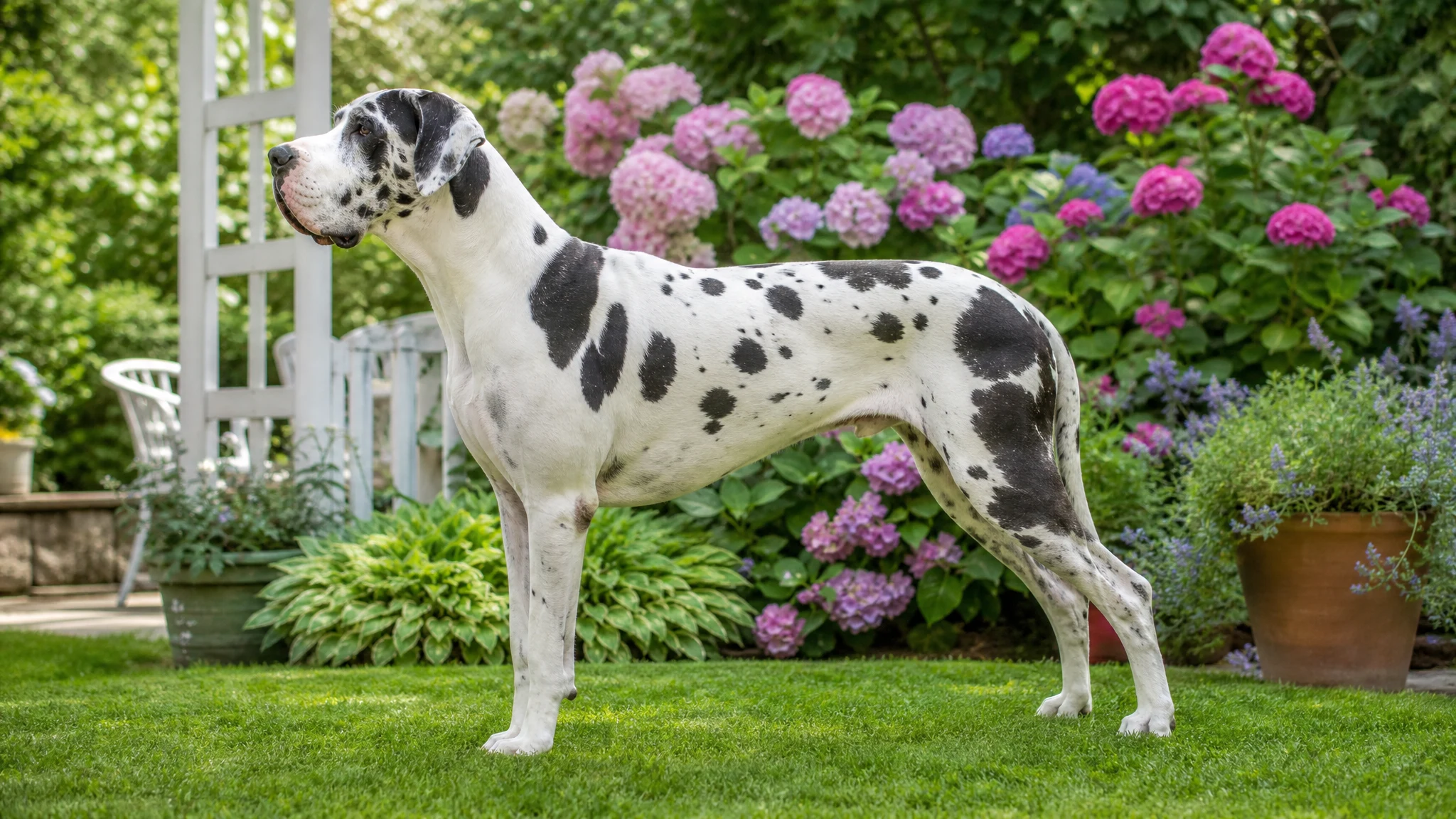
General nutrition information compiled from product labels and published sources, not veterinary advice. Your veterinarian is the right person to choose a diet for your dog, especially one with a health condition.
Great Dane nutrition is not the same as feeding an average dog, only bigger. This is a giant breed that grows fast, has a short average lifespan, and carries health risks where mealtime habits come up in the breed club's own guidance.
This guide walks you through building a Great Dane diet one decision at a time. It covers what to gather, how to read a label, how to set meal timing, and where a veterinarian has to make the call. If you are wondering what to feed a Great Dane, start here, then use the label-by-label comparison linked below for specific products.
One note on method. Everything here comes from label data and published sources. We did not run feeding trials or taste tests, and no food described here is a recommendation for your individual dog.
What You Need Before You Start
- Your dog's age in months, and a recent weight from your veterinarian's scale.
- The bag, can or tray of any food you are considering, or the brand's own product page.
- A measuring cup, so a "scoop" is a known amount.
- A notebook or phone note to log meals, treats and body condition.
- Your veterinarian's contact details, because several steps below end with "ask your vet."
Step 1: Know Your Dog's Life Stage
Life stage is the first filter. PetMD, a secondary source, lists the average adult Great Dane at 110 to 175 pounds and 28 to 32 inches tall. It also gives a life expectancy of 7 to 10 years and puts adulthood at about 18 months. PetMD advises keeping puppies on large-breed puppy food until then.
No club or veterinary school source confirmed that 18 month figure for us. Brands also differ. Royal Canin's Great Dane Adult formula is written for purebred Great Danes 24 months and older, according to the Royal Canin US product page. So ask your veterinarian when your own dog should switch.
Here are the life-stage windows some brands state on their own pages:
- Royal Canin Giant Puppy: growth, giant breed puppies up to 8 months.
- Hill's Science Diet Puppy Large Breed: large breed puppies up to 18 months.
- Hill's Science Diet Adult 6+ Large Breed: large breeds 6+ years, giant breeds 5+ years.
The senior window starts earlier for giant dogs, which fits a breed with a shorter average lifespan.
Step 2: Read the AAFCO Statement Closely
Every complete food carries a nutritional adequacy statement. The wording matters more than the front-of-bag photos.
According to Whole Dog Journal, a secondary source, AAFCO growth and all-life-stages labels must state whether the food is for growth "including" or "except for" large-size dogs, meaning 70 pounds or more as an adult. A Great Dane puppy needs a statement that says "including growth of large-size dogs."
Here is how that looks on real labels:
- Royal Canin's Giant Puppy states it is formulated for growth including growth of large size dogs (70 lb. or more as an adult).
- Victor's Hi-Pro Plus Large Breed Puppy states all life stages including the growth of large size dogs.
- Nom Nom's Beef Mash carries an all-life-stages statement that also includes growth of large size dogs.
- Hill's Science Diet Puppy Large Breed states that feeding tests substantiate complete and balanced nutrition for growing puppies. The brand's page describes it as a large breed puppy food.
For Freshpet's Vital Large Breed recipe, the label says all life stages without the large-size growth wording that we could confirm. Check the brand's page for the exact statement before using any food for a growing Dane.
Also note the difference between "formulated to meet" and "animal feeding tests." Both are valid AAFCO routes. The first is a formulation method. The second means the brand ran feeding tests. Neither tells you how a particular dog will do.
Step 3: Match Diet to the Health Topics the Breed Club Raises
The Great Dane Club of America (GDCA) health page lists several conditions where diet comes up. No food prevents or treats any of them. What follows is what the source says, and where a veterinarian decides.
Bloat (gastric dilatation-volvulus)
The GDCA calls bloat, or GDV, the number one killer of Great Danes. It says feeding multiple small meals and avoiding vigorous exercise around mealtimes may reduce risk. It also notes that a prophylactic gastropexy is an option to discuss with a veterinarian.
Royal Canin's Great Dane Adult feeding note is in the same spirit. It says the daily ration should be given in at least two meals to help reduce the risks of gastric dilation-volvulus. Freshpet's large dog recipes say amounts can be one meal or split into two. For a Dane, the GDCA's guidance points toward splitting.
The sources we reviewed do not say that a specific kibble, ingredient or food type changes bloat risk. Ask your veterinarian about meal schedule and gastropexy.
Dilated cardiomyopathy (DCM)
The GDCA says DCM is suspected to be inherited in the breed. An echocardiogram confirms the disease, and a normal result does not guarantee it will not develop later.
On diet, the FDA's page on its investigation into diets and canine DCM is the source to read. Its latest update is dated December 23, 2022. The FDA said it does not intend to release further public updates until there is meaningful new scientific information. No dietary cause has been established. Its June 2019 update called the diet and DCM association a complex scientific issue that may involve multiple factors.
So the honest summary is that the question is unsettled. Do not pick a food on the promise that it protects the heart. Talk with your veterinarian about heart screening and about your dog's food.
Hip dysplasia
The GDCA describes hip dysplasia as inherited, with multi-factorial expression, and notes that OFA and PennHIP offer certification. The page does not give feeding instructions for it. If your dog has hip concerns, your veterinarian is the person to advise on diet and body weight.
HOD and panosteitis during rapid growth
The GDCA describes HOD (hypertrophic osteodystrophy) and panosteitis as painful bone conditions of rapid puppy growth. HOD is the more serious and can be deadly.
This is the main reason large-breed puppy food is advised. PetMD, quoting the GDCA, notes that Great Danes grow very fast. We could not confirm exact calcium figures from AAFCO or a veterinary school, so we do not give any here. If a brand lists calcium on its page, read it, and ask your veterinarian whether it suits your puppy. Never add calcium or other supplements on your own.
Step 4: Compare Calorie Density Per Cup
Calorie density is how weight management starts on paper. Two foods can fill the same cup and differ a lot in energy. These figures come from each brand's own page:
| Food | Form | Calories listed |
|---|---|---|
| Royal Canin Giant Puppy | Dry | 338 kcal ME per cup |
| Freshpet Vital Large Breed | Fresh | 337 kcal per cup |
| Freshpet Large Dog Multi-Protein | Fresh | 348 kcal per cup |
| Hill's Adult 6+ Large Breed | Dry | 352 kcal per cup |
| Hill's Adult Large Breed | Dry | 365 kcal per cup |
| Victor Hi-Pro Plus Large Breed Puppy | Dry | 365 kcal per cup |
| Hill's Puppy Large Breed | Dry | 387 kcal per cup |
| Royal Canin Great Dane Adult | Dry | 390 kcal ME per cup |
| Royal Canin Giant Adult | Dry | 427 kcal ME per cup |
| Nom Nom Beef Mash | Fresh | 201 kcal per cup |
Royal Canin's figures are calculated, as fed. A cup of one food is not a cup of another. If you switch brands and keep the same scoop, your dog's daily calories can shift by a lot. For example, going from a 338 kcal cup to a 427 kcal cup is roughly a quarter more energy per cup.
For puppies, a leaner calorie plan is a topic to raise with your veterinarian, because rapid growth is the concern the GDCA names. We found no source in our research that gives a calorie target per day for Danes, so we do not state one.
Step 5: Use Feeding Guides as Starting Points
Label feeding charts are starting points, not prescriptions. A few examples of what brands say:
- Hill's pages say to adjust feeding amounts as necessary to maintain optimal weight, and to ask your veterinarian if you are unsure.
- Victor's large breed puppy page says that after age one, feed to maintain good body condition, using the feeding chart as a guide.
- Nom Nom says its daily recommendations are only a guide and may vary with age, weight and activity level.
- Freshpet's Large Dog Multi-Protein page lists 3 1/2 cups per day for dogs 81+ lbs, plus 3/4 cup per additional 25 lbs over 80.
Royal Canin's giant formulas link to a feeding calculator rather than fixed amounts, so use the calculator on the brand page. Start there, then adjust by how your dog looks and feels, with your veterinarian's input.
Step 6: Build the Meal Routine
- Divide the daily amount into at least two meals, in line with the GDCA's note about multiple small meals.
- Measure each meal with a real cup or a scale.
- Keep vigorous exercise away from mealtimes, as the GDCA advises.
- Count treats and chews toward the daily total.
- Change foods gradually, and ask your veterinarian how slowly to go for your dog.
- Write down what you feed and how your dog's body condition looks every few weeks.
Step 7: Check the Ingredient List and Food Type
Ingredients tell you what the food is made from, not whether it is better. A few facts from the labels:
- Royal Canin Great Dane Adult lists chicken fat, chicken by-product meal, tapioca, brewers rice and corn first. The brand states a kibble that is large and textured, designed for the Great Dane's large jaw.
- Hill's Adult Large Breed lists chicken, cracked pearled barley, brown rice, brewers rice and whole grain wheat first.
- Victor Hi-Pro Plus lists chicken, chicken meal, brown rice, whole grain millet and whole grain sorghum first.
- Freshpet and Nom Nom list meats, eggs and vegetables first. We could not confirm whether those recipes are grain free, so check each brand.
Kibble size is not listed on most of the pages we reviewed, so check with the brand if it matters for your dog.
On guaranteed analysis, Royal Canin Great Dane Adult lists a minimum of 21 percent protein and 23 percent fat. Victor's Hi-Pro Plus lists 30 percent protein and 14 percent fat. Hill's pages show average dry matter values rather than guaranteed minimums, so you cannot compare them directly with the others.
Some Hill's products also include a canned adult recipe, but its feeding chart is general rather than breed specific and it is listed per can, not per cup. Compare it by can.
To see these side by side, use our label-by-label comparison of dog foods for Great Danes.
Tips and Common Mistakes
- Using a puppy food that excludes large dogs. Check the AAFCO statement for the "including growth of large-size dogs" wording.
- Feeding one big meal. The GDCA's guidance points toward multiple small meals.
- Exercising right after eating. The GDCA says to avoid vigorous exercise around mealtimes.
- Switching brands at the same scoop size. Calories per cup differ widely, as the table shows.
- Adding supplements to a complete food. Ask a veterinarian first, especially for a growing puppy.
- Choosing a food for heart claims. The FDA says no dietary cause of DCM has been established.
- Treating a prescription diet as a shopping choice. Prescription diets are something only a veterinarian prescribes.
- Assuming a normal heart test settles it. The GDCA notes a normal echocardiogram does not guarantee DCM will not develop later.
What Results to Expect
A well-chosen, correctly measured diet may help your dog hold a steady, healthy body condition over time. A routine of split meals may lower the risk of bloat, according to the GDCA, but it cannot remove it. No diet can promise to prevent inherited conditions such as DCM or hip dysplasia.
Over the first few weeks on a new plan, you may notice steadier appetite, consistent stools and a stable weight. Those are signs to share with your veterinarian, not proof that the food is right. Because puppies change quickly, plan regular weight checks and adjust the amounts with your veterinarian.
When to Call Your Veterinarian
Ask your veterinarian before changing food if your dog is a puppy, is overweight or underweight, has a heart or joint diagnosis, or has digestive trouble. A veterinarian decides what is right for an individual dog, and only a veterinarian can prescribe a therapeutic diet.
Bloat is an emergency. If you are unsure whether your dog is showing signs, call your veterinarian or an emergency clinic right away.
Sources
- Great Dane Club of America, Health page
- Great Dane Club of America
- FDA CVM, Investigation into Potential Link between Certain Diets and Canine DCM
- PetMD, Great Dane breed page (secondary source)
- Whole Dog Journal, In the Fine Print: Nutritional Adequacy Statements (secondary source)
- Royal Canin US, Great Dane Adult
- Hill's Pet Nutrition, Science Diet Adult Large Breed
- Victor Pet Food, Hi-Pro Plus Large Breed Puppy
- Freshpet, Large Dog Multi-Protein Recipe