Dog Food for a Great Dane Puppy: Portion Sizes by Week
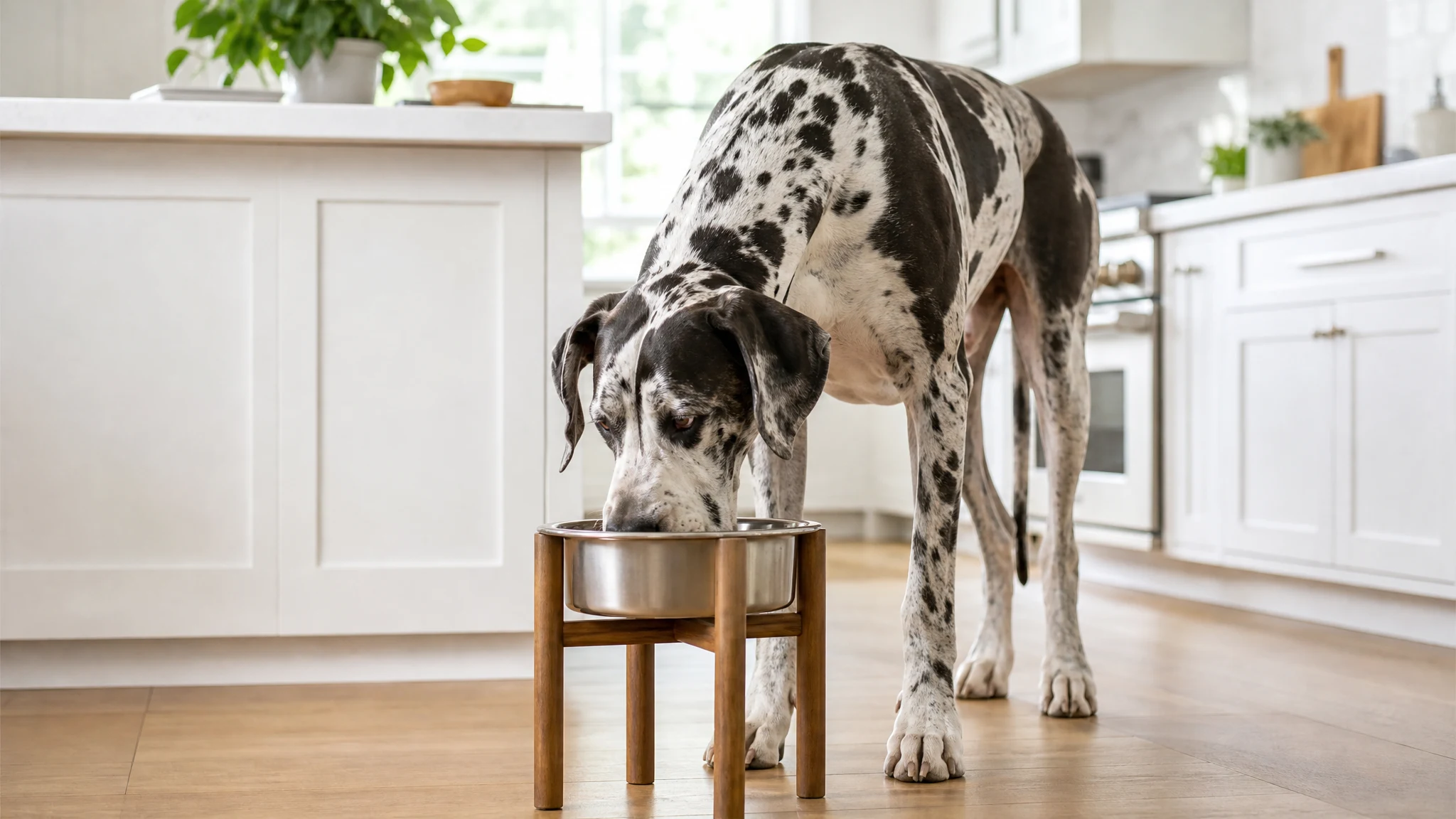
General nutrition information compiled from product labels and published sources, not veterinary advice. Your veterinarian is the right person to choose a diet for your dog, especially one with a health condition.
Great Danes grow fast, and that makes feeding a puppy feel like a moving target. The right amount in week 10 is not the right amount in week 20.
Here is the honest starting point. The brands we looked at do not publish one fixed amount for each week of a Great Dane puppy's life. They publish label guides based on a dog's weight and age. So this guide shows you how to turn those label guides into a weekly routine, and how to adjust as your puppy grows.
The method is simple. We compared label data from brand pages. We did not run feeding trials or taste tests, and we have not fed these products to any dog.
What You Need
- A food whose label says it suits the growth of large-size dogs (see Step 1).
- A dry measuring cup, or a kitchen scale if your food's label gives weights.
- A way to weigh your puppy each week. Many owners use a bathroom scale: weigh yourself, then yourself holding the puppy, and subtract. Early on, a vet clinic scale works too.
- A notebook or phone note for weight, cups per day, and stool quality.
- The feeding guide printed on the bag, or on the brand's own page.
- Your veterinarian's phone number, for check-ins.
Step 1: Pick a Food That Fits Giant-Breed Growth
Start with the label, not the front of the bag. Whole Dog Journal, a secondary source, explains that AAFCO growth and all-life-stages labels must say whether the food is for growth "including" or "except for" large-size dogs, meaning dogs of 70 pounds or more as adults. A Great Dane needs a statement that says "including growth of large-size dogs."
PetMD, also a secondary source, advises keeping Great Dane puppies on large-breed puppy food until about 18 months. Ask your veterinarian to confirm the timing for your own dog.
Here are a few label examples from brand pages, so you can see what the wording looks like:
- Royal Canin Giant Puppy Dry: the AAFCO statement covers growth including growth of large size dogs. It is aimed at giant breed puppies up to 8 months. The listed kcal is 338 per cup (as fed, calculated). Protein is 32% minimum and fat is 12% minimum.
- Victor Hi-Pro Plus Large Breed Puppy: labeled for all life stages including growth of large size dogs. It lists 365 kcal per cup, with 30% protein minimum and 14% fat minimum.
- Hill's Science Diet Puppy Large Breed Chicken & Brown Rice: its statement says it provides complete and balanced nutrition for growing puppies. It is described for large breed puppies up to 18 months and lists 387 kcal per cup. Hill's shows average dry matter values, not guaranteed minimums.
- Nom Nom Beef Mash (fresh): labeled for all life stages including growth of large size dogs. It lists 201 kcal per cup, so cup amounts will look very different from kibble.
Notice how much kcal per cup varies. That is why you should never copy a friend's "cups per day" for a different food. You can read each brand's own page: Royal Canin Giant Puppy, Victor Hi-Pro Plus Large Breed Puppy, and Hill's Science Diet Puppy Large Breed.
Step 2: Find Your Puppy's Starting Amount on the Label
Use the feeding guide for your puppy's current weight and age. Treat the number as a starting point, not a target.
Brands handle this differently. The Royal Canin Giant Puppy page links to a feeding calculator rather than listing fixed amounts. Hill's tells owners to adjust amounts as necessary to maintain optimal weight, and to ask a veterinarian if unsure. Victor says that after age one, you should feed to maintain good body condition, using the chart as a guide.
Fresh foods publish amounts by dog weight too. For example, Freshpet's Vital Large Breed recipe lists 2 1/2 to 3 cups per day for dogs at 51 to 65 pounds, as one meal or split into two. That chart is for the weight of the dog, so use the row that matches your puppy's weight today, not the weight you expect later.
For a broader look at amounts across the whole first two years, see our Great Dane feeding chart by age.
Step 3: Split the Day Into Several Meals
The Great Dane Club of America (GDCA) health page calls bloat, also known as GDV, the number one killer of Great Danes. It says feeding multiple small meals and avoiding vigorous exercise around mealtimes may reduce risk. It also says a prophylactic gastropexy is an option to discuss with your vet.
Royal Canin's Great Dane Adult page makes a similar point, advising that the daily ration be given in at least two meals to help reduce the risk of gastric dilation-volvulus.
So take the daily amount from Step 2 and divide it into several equal meals. Many owners of young puppies use three or more, then move to two as the puppy matures. Your vet can tell you the right schedule for your dog.
Step 4: Weigh Weekly and Adjust the Amount
This step replaces a fixed "week by week" chart. Because puppies grow at different speeds, your own scale is more reliable than a generic table.
- Weigh your puppy on the same day each week, at the same time of day.
- Write down the weight and the cups fed per day.
- Look up the new weight on the label guide. If the guide now lists a larger amount, increase the daily total a little and split it across the same meals.
- Check body condition. You should be able to feel the ribs under a light covering of flesh, and see a waist from above. If you cannot feel ribs, ask your vet whether to trim back.
The GDCA health page describes HOD and panosteitis as painful bone conditions of rapid puppy growth, with HOD the more serious and potentially deadly. The source does not offer a feeding formula to prevent them. What it supports is this: watch growth, keep your puppy on a suitable large-breed puppy food, and tell your vet quickly about limping, swelling or pain.
Step 5: Keep Meals Calm and Routine
Feed at the same times each day. Use a quiet spot. Give your puppy a rest period after meals instead of play or hard exercise, in line with the GDCA's advice to avoid vigorous exercise around mealtimes.
Reward-based training pairs well with mealtimes. You can use a small part of the daily kibble as training rewards, then subtract it from the bowl so the daily total stays steady.
Step 6: Plan the Move to Adult Food
PetMD puts adulthood at about 18 months for a Great Dane. Royal Canin's breed-specific adult formula is listed for purebred Great Danes 24 months and older, so brands do not agree on a single age. Ask your vet when to switch.
When the time comes, change foods slowly over about a week or two, mixing a little more of the new food into the old each day. This is a common practice, not a rule from any source above, so ask your vet if your puppy has a sensitive stomach.
Tips for Better Results
- Compare kcal per cup, not just cups. A cup of one food can carry quite a different amount of energy than a cup of another, as the examples in Step 1 show.
- Count treats. Extra calories can quietly push a puppy into faster growth.
- Use a real measuring cup. Scoops and coffee mugs vary.
- Keep one food at a time. Changing brands often makes it hard to tell what is working.
- Read the first ingredients. They show what the recipe leads with, but they do not prove a food is better. A name on the front can say more about marketing than nutrition.
Common Mistakes to Avoid
- Using a food labeled "except for growth of large-size dogs." That wording means it is not meant for a Great Dane puppy.
- Feeding one or two big meals. This goes against the club's advice on smaller, multiple meals.
- Treating the label amount as fixed. It is a starting point. Your puppy's weight and body condition tell you more.
- Adding supplements on your own. Do not add calcium or other supplements unless your vet tells you to. We do not give supplement amounts, and none of the sources above does either.
- Chasing rapid growth. A bigger puppy is not a healthier puppy.
- Switching to adult food too early or too late. Confirm timing with your vet.
A Note on DCM and Grain-Free Questions
Many owners ask about heart disease. The GDCA says dilated cardiomyopathy (DCM) is suspected to be inherited in the breed, and that an echocardiogram confirms it. A normal result does not guarantee it will not develop later.
The FDA's investigation page says no dietary cause has been established, and that its June 2019 update called the diet and DCM link a complex scientific issue that may involve multiple factors. The latest update on that page is dated December 23, 2022, and the FDA said it does not plan more public updates until there is meaningful new scientific information. Talk with your vet about your own puppy's heart screening and diet.
What to Expect
If you follow these steps, you may find that feeding becomes more predictable. Many owners see steadier weight gain and firmer, more regular stools once the food, schedule and amounts stay consistent. Results vary by puppy, and no food can promise a particular outcome.
No food prevents or treats hip dysplasia, bloat, DCM or bone disease. The GDCA notes that hip dysplasia is inherited with multi-factorial expression, so diet is only one piece. If your puppy has a health condition, or you are unsure about amounts, confirm them with your veterinarian. Prescription diets are something only a veterinarian prescribes.
Quick Recap
- Choose a food whose label says it covers growth of large-size dogs.
- Find the label starting amount for your puppy's current weight.
- Split the day into several small meals.
- Weigh weekly and adjust.
- Keep meals calm, with rest afterward.
- Plan the move to adult food with your vet.
Sources
- Great Dane Club of America, Health page
- PetMD Great Dane breed page
- Whole Dog Journal, In the Fine Print: Nutritional Adequacy Statements
- FDA CVM, Investigation into Potential Link between Certain Diets and Canine DCM
- Royal Canin Great Dane Adult product page
- Royal Canin Giant Puppy product page
- Hill's Science Diet Puppy Large Breed product page
- Victor Hi-Pro Plus Large Breed Puppy product page
- Freshpet Vital Large Breed product page
- Nom Nom Beef Mash product page