Great Dane Bloat Prevention: Feeding Habits That May Help
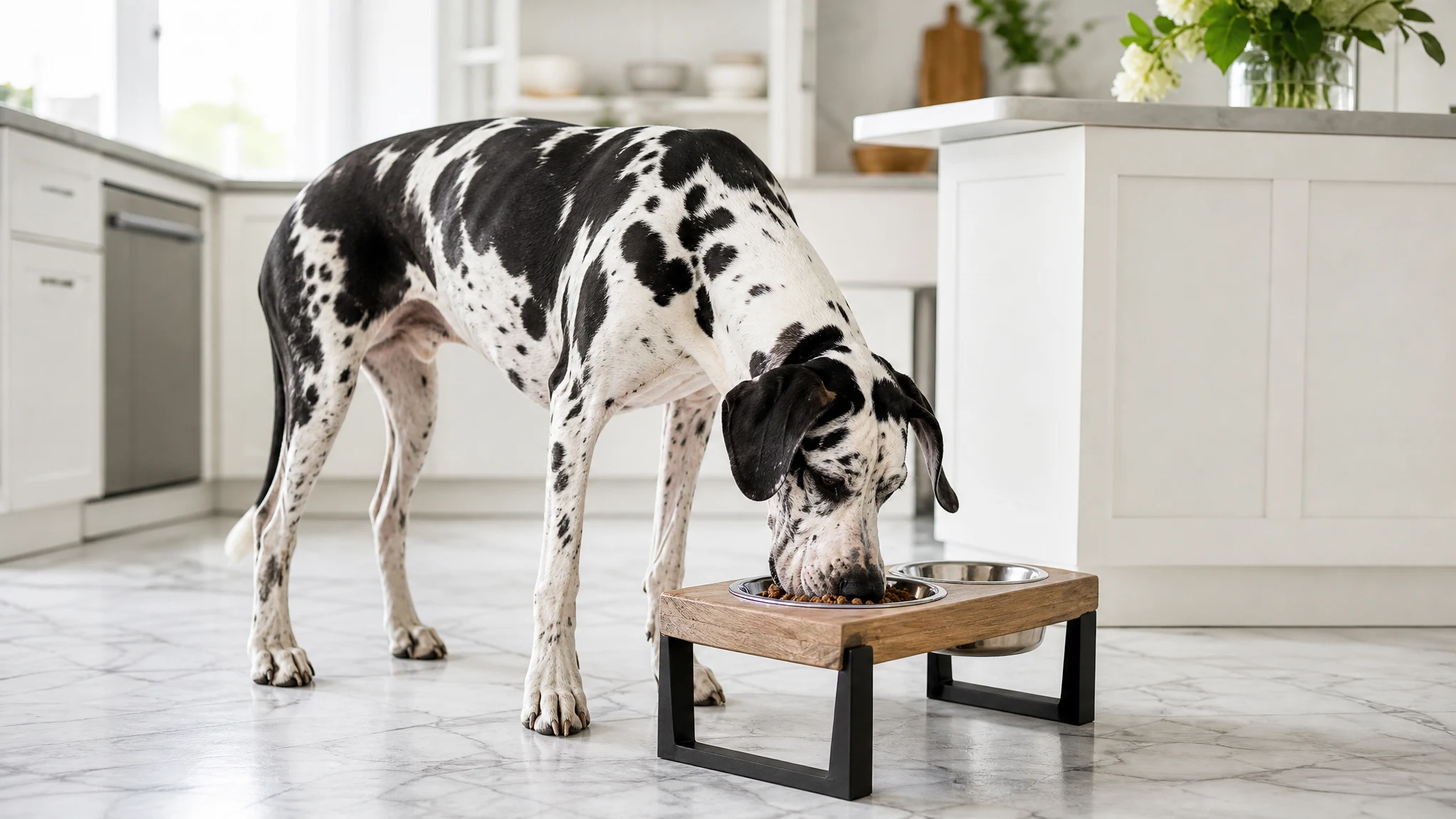
General nutrition information compiled from product labels and published sources, not veterinary advice. Your veterinarian is the right person to choose a diet for your dog, especially one with a health condition.
Bloat is the health topic that worries Great Dane owners most, and for good reason. The Great Dane Club of America (GDCA) health page calls bloat, also known as gastric dilatation-volvulus (GDV), the number one killer of the breed.
No feeding routine can promise a dog will never bloat. But the GDCA says feeding multiple small meals and avoiding vigorous exercise around mealtimes may reduce risk. This guide turns that advice into a daily routine you can follow, and it explains where food labels fit in.
What bloat is, in plain words
GDV is an emergency in which the stomach swells and can twist. The GDCA lists it among the diet-relevant health concerns for the breed, along with dilated cardiomyopathy, hip dysplasia and the bone conditions of fast puppy growth.
Feeding habits are one piece of great dane bloat prevention. They are not a cure and not a guarantee. Your veterinarian decides what is right for your individual dog.
Materials you need
- A measuring cup, or a kitchen scale if your vet prefers weighing food.
- The bag or can of your dog's current food, with its feeding guide and nutritional adequacy statement.
- A notebook or phone note to log meals, exercise and any odd behavior.
- A dependable clock or phone alarm for meal times.
- Your veterinarian's number and the number of the nearest 24-hour emergency clinic, saved in your phone.
Step-by-step: a feeding routine that may help
Step 1: Find your dog's starting amount from the label
Read the feeding guide on your dog's food. Label guides are starting points. They use weight, and sometimes age, and your dog's activity level and body condition may call for adjusting up or down.
Adult Great Danes commonly weigh 110 to 175 pounds and stand 28 to 32 inches tall, according to PetMD. That is a wide range, so use your own dog's weight, not an average. For age-based guidance, see our Great Dane feeding chart by age.
The calories per cup differ a lot between foods. Royal Canin lists 390 kcal ME per cup for its Great Dane Adult formula, while its Giant Puppy formula lists 338 kcal ME per cup. A cup of one food is not the same as a cup of another, so recheck the amount whenever you change foods.
Step 2: Split the daily amount into several smaller meals
Take the total for the day and divide it. The GDCA health page advises multiple small meals. It does not give one required number, so ask your vet whether two, three or more meals suit your dog.
Some brands say the same thing on the label. The Royal Canin Great Dane Adult product page states that the daily ration should be given in at least two meals to help reduce the risks of gastric dilation-volvulus. Freshpet's large-dog pages say their amounts can be served as one meal or divided into two. For a breed with this risk, ask your vet before choosing the one-meal option.
Do not add the split meals on top of the old amount. The total for the day stays the same.
Step 3: Keep mealtimes at the same hours
Set alarms and feed at the same times each day. A steady rhythm makes it easier to plan exercise around meals. It also helps you notice when your dog skips a meal or acts unlike themselves.
Step 4: Plan exercise away from meals
The GDCA says to avoid vigorous exercise around mealtimes. The club's page does not state an exact waiting time, so ask your vet how long to keep things calm before and after meals for your dog.
In practice, that means no hard games of fetch, no dog park wrestling and no sprinting right before or after the bowl comes out. A quiet walk or a rest on the couch is a calmer choice.
Step 5: Check that the food suits a giant breed
Growth stage matters. PetMD advises keeping Great Dane puppies on large-breed puppy food until about 18 months. It notes that no club or veterinary school source was confirmed for that age, so confirm timing with your vet.
On the label, look at the nutritional adequacy statement. Whole Dog Journal explains that growth and all-life-stages foods must say whether they are for growth including or except for large-size dogs, meaning 70 pounds or more as an adult. A Great Dane needs a statement that says including growth of large-size dogs.
Examples of label wording that includes large-size growth, as the brands state it:
- Royal Canin Giant Puppy: growth including growth of large size dogs.
- Victor Hi-Pro Plus Large Breed Puppy: all life stages including growth of large size dogs.
- Nom Nom Beef Mash: all life stages including growth of large size dogs.
We compared label data only. We did not run feeding trials or taste tests, and a label cannot tell you how a particular dog will do on a food. Hill's lists its Science Diet Puppy Large Breed for large breeds with an adult weight over 55 pounds, so check its page and ask your vet whether it fits a Great Dane.
Step 6: Change foods slowly and keep notes
Whenever you switch foods or meal counts, write down what changed and how your dog seemed afterward. Bring the notes to your vet. Because calories per cup vary from food to food, your vet can help you adjust the amount rather than copying the old cup count.
Step 7: Talk to your vet about a gastropexy
The GDCA names prophylactic gastropexy as an option to discuss with a vet. Feeding habits and surgery are different tools, and only your veterinarian can say whether surgery makes sense for your dog. Raise the question early, ideally before an emergency.
Tips
- Keep the household on the same plan. Tell everyone who feeds the dog about the meal times, the amounts and the quiet period.
- Count treats and chews toward the day's food. Extra food can push a dog over the intended amount.
- Feed multi-dog homes separately, so no one rushes or guards a bowl.
- Re-weigh your dog regularly and adjust amounts with your vet as weight and activity change.
- Know the nearest emergency clinic ahead of time, including its hours.
Common mistakes to avoid
- Feeding one big meal because it is convenient. The GDCA's advice points the other way, toward several smaller meals.
- Heavy play right after eating. Exercise around mealtimes is what the club says to avoid.
- Trusting the front of the bag. Marketing terms such as "giant breed" are not the same as the adequacy statement. Read the fine print.
- Switching to a puppy-to-adult food too early or too late. Confirm timing with your vet instead of guessing from the calendar.
- Treating a food as a bloat or heart fix. No food has been shown to prevent GDV, and diet does not replace veterinary care.
- Waiting to see if it passes. If your dog seems distressed or something seems wrong, call your vet or an emergency clinic right away.
A note on DCM and grain-free claims
Owners often ask about heart disease when choosing food. The GDCA says dilated cardiomyopathy is suspected to be inherited in the breed. It also says an echocardiogram confirms the disease and that a normal result does not guarantee it will not develop later.
The FDA's investigation into diets and canine DCM has a latest update dated December 23, 2022. The agency said it does not intend to release further public updates until there is meaningful new scientific information. No dietary cause has been established, and the FDA called the issue complex and possibly involving multiple factors. Ask your vet to review your dog's diet and heart health together.
What results to expect
A steady routine of smaller meals, calm mealtimes and a food suited to giant breeds may help lower the chance of bloat. It cannot remove the risk. Great Danes can still bloat even when owners do everything right, which is why knowing your emergency options matters.
You may also find that mealtimes become more predictable and that you spot changes in appetite or behavior sooner. Those are practical benefits, but they are not medical outcomes.
For a dog with a health condition, a history of bloat, or a weight problem, confirm every amount and meal schedule with your veterinarian before changing anything. Do not add supplements without your vet's direction.
Quick recap
- Start from the label feeding guide and your dog's actual weight.
- Split the day's food into several smaller meals.
- Keep meal times consistent.
- Avoid vigorous exercise around meals, and ask your vet how long.
- Check the adequacy statement for large-size growth in puppy foods.
- Change foods slowly and keep notes.
- Discuss gastropexy with your vet.