Great Dane Feeding Chart by Weight and Age
General nutrition information compiled from product labels and published sources, not veterinary advice. Your veterinarian is the right person to choose a diet for your dog, especially one with a health condition.
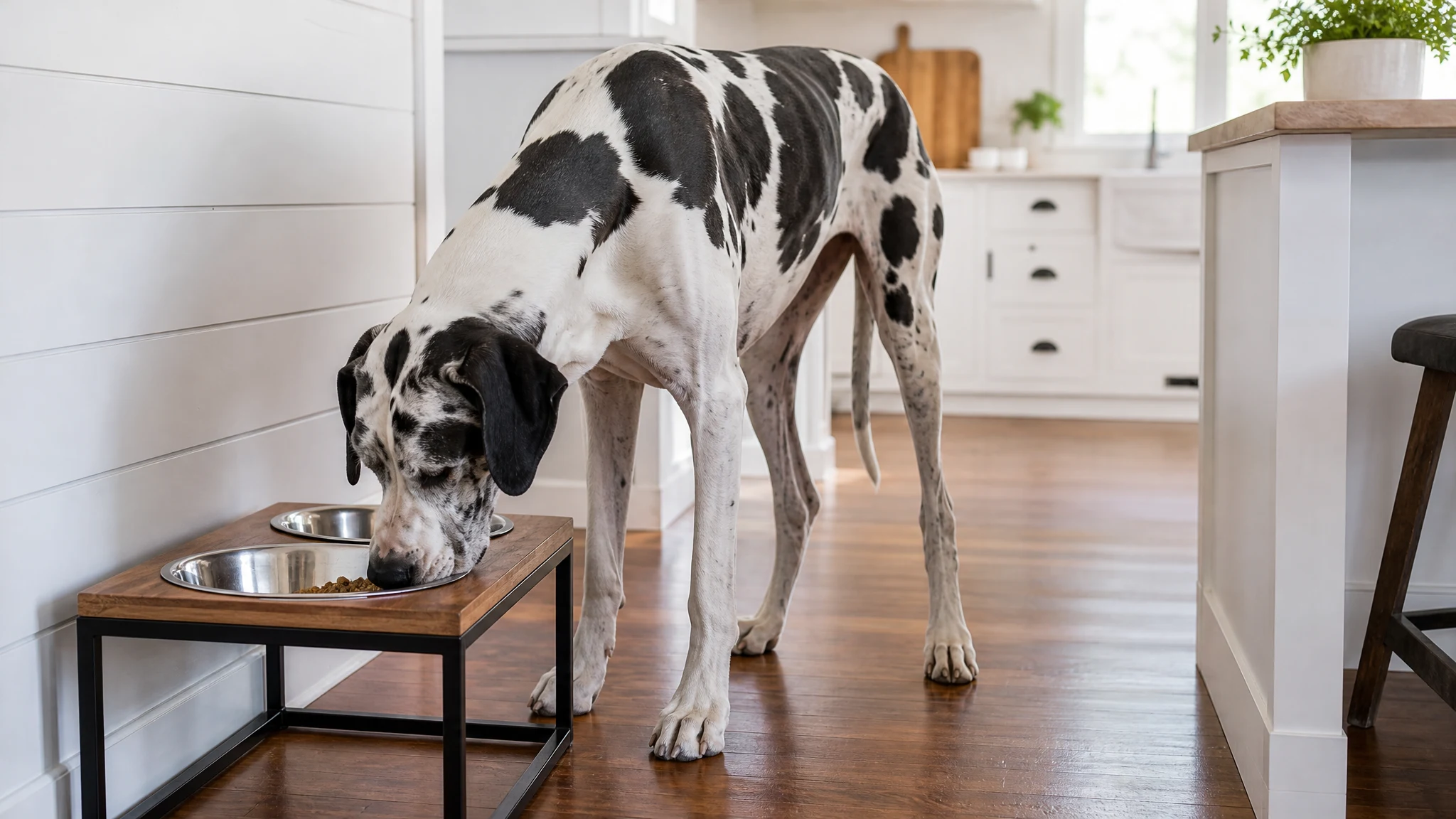
A Great Dane changes size fast, so one bag and one scoop rarely stay right for long. This guide shows you how to build a simple great dane feeding chart for your own dog. You will use the food label, your dog's age, current weight and activity level.
One note on method. We compared label data from the brands named below. We did not run feeding trials or taste tests. Nothing here replaces your veterinarian, who decides what is right for an individual dog.
What You Need
- The bag or can of your dog's current food, with the nutritional adequacy (AAFCO) statement and feeding guide
- A kitchen scale or a marked measuring cup
- A floor scale or your vet's scale for regular weigh-ins
- A notebook or phone note for weights, meals and body condition
- Your veterinarian's contact details, for questions and check-ups
Step 1: Know Where Your Dog Is in Life
PetMD, a secondary source, lists the average adult Great Dane at 110 to 175 pounds and 28 to 32 inches tall. It also puts life expectancy at 7 to 10 years. PetMD advises keeping puppies on large-breed puppy food until about 18 months. It says no club or vet-school source confirmed that exact age, so ask your vet when to switch.
Brands set their own age ranges, which is why charts differ. Royal Canin Giant Puppy is for giant puppies up to 8 months. Hill's Science Diet Puppy Large Breed runs to 18 months. Royal Canin's Great Dane Adult is for purebred Great Danes 24 months and older. Read the stage on your food, then confirm the timing with your vet.
Step 2: Check the Label Wording for Large Puppies
For a growing Great Dane, the adequacy statement matters more than the front of the bag. Whole Dog Journal, a secondary source, explains that growth and all-life-stages labels must say whether the food is for growth "including" or "except for" large-size dogs, meaning 70 pounds or more as an adult. A Great Dane needs the "including growth of large-size dogs" wording.
Some labels in our comparison use that wording. Royal Canin Giant Puppy, Victor Hi-Pro Plus Large Breed Puppy and Nom Nom Beef Mash all state it. Hill's Science Diet Puppy Large Breed states it as complete and balanced nutrition for growing puppies, so check the full statement on the bag.
The Great Dane Club of America (GDCA) health page describes HOD and panosteitis as painful bone conditions of rapid puppy growth, and says HOD is the more serious and can be deadly. No food is claimed to prevent them here. Ask your vet how fast your puppy should be growing.
Step 3: Build the Chart From the Label
The table below is a starting framework, not a prescription. It matches life stage to label details from each brand's own page. The amounts always come from the feeding guide printed on your food.
| Life stage | Example label | Label details | Amount |
|---|---|---|---|
| Giant puppy, up to 8 months | Royal Canin Giant Puppy | 338 kcal ME per cup (calculated); protein 32% min, fat 12% min | Brand links to a feeding calculator; no fixed amounts listed |
| Large puppy, to 18 months | Hill's Science Diet Puppy Large Breed | 387 kcal per cup | Use the bag chart; adjust to maintain optimal weight |
| Growth, all life stages | Victor Hi-Pro Plus Large Breed Puppy | 365 kcal per cup; protein 30% min, fat 14% min | After age one, feed to maintain good body condition |
| Adult Great Dane | Royal Canin Great Dane Adult | 390 kcal ME per cup (calculated); large, textured kibble | Give the daily ration in at least two meals |
| Adult giant breed | Royal Canin Giant Adult | 427 kcal ME per cup (calculated) | Brand links to a feeding calculator |
| Mature giant breed, 5+ years | Hill's Science Diet Adult 6+ Large Breed | 352 kcal per cup | Use the bag chart; ask your vet if unsure |
Notice the calorie range. A cup of Royal Canin Giant Adult carries 427 kcal, while a cup of Hill's Science Diet Adult 6+ carries 352. Two dogs eating "one cup" of different foods are getting different amounts of energy. That is why you should never copy a cup count from another owner.
For more on age-based amounts, see our page on the Great Dane feeding chart by age.
Step 4: Use Weight and Activity to Set a Starting Amount
Find your dog's current weight on the feeding guide, not the weight you hope for. Some guides stop below Great Dane size. Hill's chart for its canned Adult Chicken & Barley Entree runs to 120 pounds. The Freshpet Large Dog Multi-Protein Recipe guide lists 3 1/2 cups per day for 81 pounds and up, plus 3/4 cup for each additional 25 pounds over 80. Freshpet says this can be one meal or split into two.
Treat any figure as a starting point. Nom Nom says its daily recommendations are only a guide and may vary with age, weight and activity level. A very active young adult may need more than the guide. A calm older dog may need less. Hill's advises adjusting amounts as necessary to maintain optimal weight, and asking your veterinarian if you are unsure.
Step 5: Split the Day Into Smaller Meals
The GDCA health page calls bloat (gastric dilatation-volvulus, or GDV) the number one killer of Great Danes. It says feeding multiple small meals and avoiding vigorous exercise around mealtimes may reduce risk. It also lists a prophylactic gastropexy as an option to discuss with a vet.
In practice, that means dividing the daily amount into at least two meals. Royal Canin's Great Dane Adult guide says the same. Keep the minutes before and after meals calm. Your vet can help you set a schedule that fits your dog.
Step 6: Weigh, Record and Adjust
- Weigh your dog every few weeks as a puppy, and less often as an adult. Write down the date and weight.
- Note body condition. You should be able to feel the ribs under a light covering of fat.
- If weight climbs or drops faster than your vet expects, change the amount in small steps.
- Change foods slowly, mixing the new food in over several days, to limit stomach upset.
- Share your notes at each vet visit.
Tips for Reading Labels Without Being Swayed by Marketing
- Check the adequacy statement first. Hill's products cite animal feeding tests using AAFCO procedures. Others state they are formulated to meet AAFCO nutrient profiles. These are different ways of supporting a claim.
- Compare calories per cup, not only protein. Calorie density drives how much ends up in the bowl.
- Look at guaranteed minimums. Hill's pages show average dry matter values, not guaranteed minimums, so they are not directly comparable to a guaranteed analysis.
- Do not assume "grain free" is better. The foods compared here that list grain status are not grain free, and for Freshpet and Nom Nom the brand pages should be checked.
- On the DCM question, the FDA's last update on its investigation is dated December 23, 2022. FDA says no dietary cause has been established, and it called the diet and DCM link a complex scientific issue that may involve multiple factors. The GDCA says DCM is suspected to be inherited in the breed. Talk to your vet about your dog's heart screening and diet.
Common Mistakes to Avoid
- Using an adult food too early. Check the large-size growth wording before you move on from puppy food.
- Feeding one big meal. A single large serving goes against the bloat guidance above.
- Exercising right after meals. The GDCA advises avoiding vigorous exercise around mealtimes.
- Trusting a cup count from a different food. Calories per cup vary widely.
- Skipping the weigh-in. A chart only works if it is checked against your dog's real weight.
- Changing diet for a health condition without your vet. Dogs with heart, joint, weight or digestive problems need amounts confirmed by a veterinarian. Prescription diets are something only a vet prescribes.
- Adding supplements on your own. Ask your vet first. We do not give supplement amounts.
What to Expect
Used carefully, a label-based chart may help you feed in a steady, consistent way and notice weight changes early. Many owners find that regular weigh-ins and notes make vet conversations easier. Results vary by dog. Genetics, growth rate, activity and health all play a part, and no feeding plan can promise a particular outcome.
Hip dysplasia is inherited with multi-factorial expression, according to the GDCA, and OFA and PennHIP offer certification. Food alone does not decide it, so keep diet one part of the conversation with your vet and breeder.
Where to Check Amounts
For exact amounts, go to the brand's own page and your bag. Royal Canin, Hill's, Victor, Freshpet and Nom Nom each publish their own feeding guidance, and details such as kibble size are not listed for every product. Contact the brand if a detail is missing.
Sources
- Great Dane Club of America, Health page
- PetMD Great Dane breed page
- FDA CVM, Investigation into Potential Link between Certain Diets and Canine DCM
- Whole Dog Journal, In the Fine Print: Nutritional Adequacy Statements
- Royal Canin, Great Dane Adult
- Royal Canin, Giant Puppy
- Royal Canin, Giant Adult
- Hill's Science Diet, Puppy Large Breed
- Hill's Science Diet, Adult 6+ Large Breed
- Hill's Science Diet, Adult Chicken & Barley Entree (canned)
- Victor, Hi-Pro Plus Large Breed Puppy
- Freshpet, Large Dog Multi-Protein Recipe
- Nom Nom, Beef Mash