Great Dane Feeding Chart: How Many Meals a Day
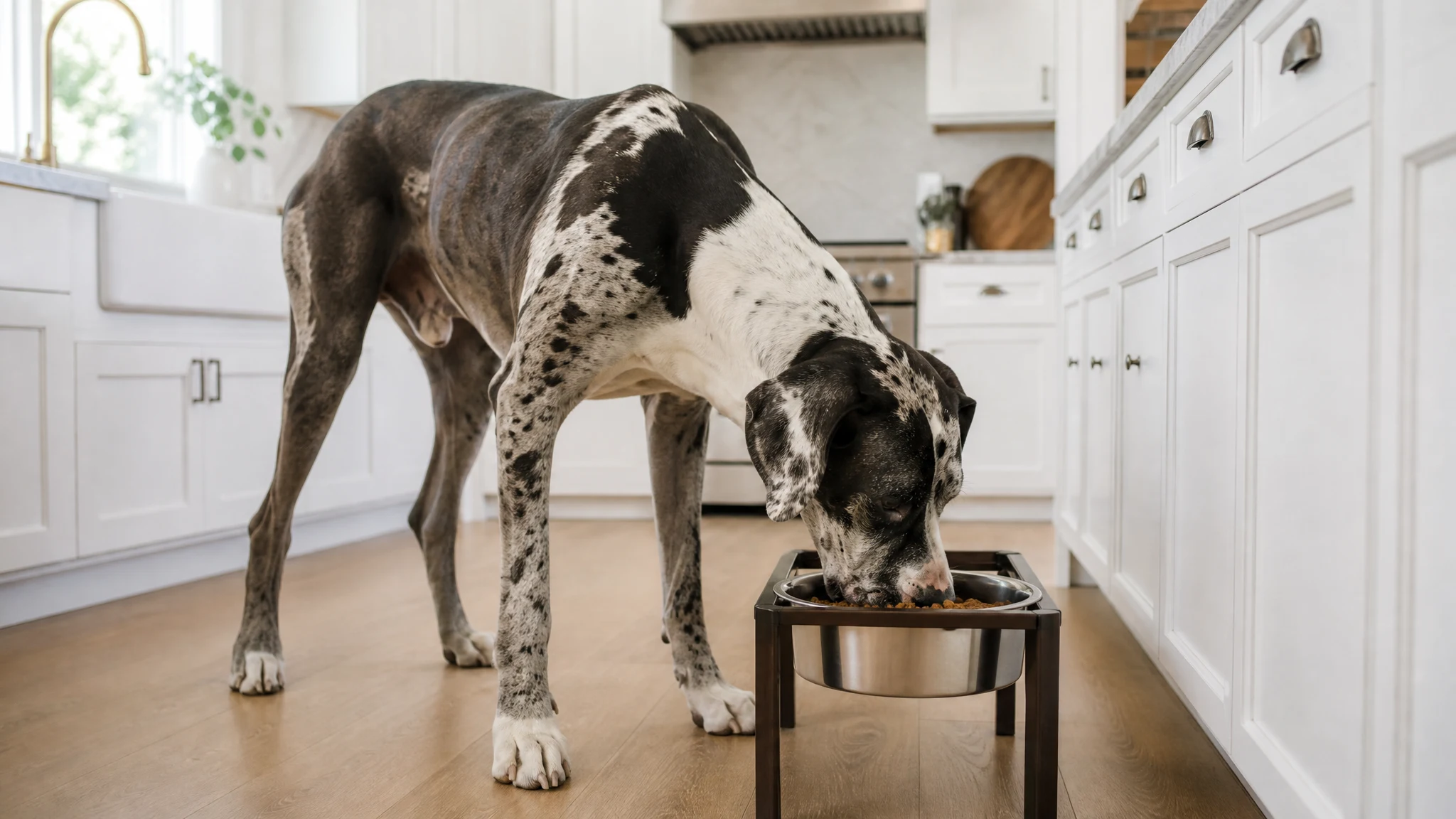
General nutrition information compiled from product labels and published sources, not veterinary advice. Your veterinarian is the right person to choose a diet for your dog, especially one with a health condition.
A Great Dane feeding chart answers two questions: how much, and how often. This guide focuses on the second one. It shows you how to build a simple meal schedule for a giant dog, step by step.
The Great Dane Club of America (GDCA) Health page calls bloat, also known as GDV (gastric dilatation-volvulus), the number one killer of the breed. It says feeding multiple small meals and avoiding vigorous exercise around mealtimes may reduce risk. That makes meal timing worth getting right.
For amounts by age, see our Great Dane feeding chart by age. This page covers the schedule that goes around those amounts.
How we approached this
We compared label data and published breed guidance. We did not run feeding trials or taste tests, and we did not feed any of these foods to dogs. Treat every number below as a starting point to discuss with your veterinarian, not as a prescription.
What you need
- A dry measuring cup, or a kitchen scale if your food's label gives weights.
- The bag or can of your dog's current food, so you can read the label.
- A food bowl that sits at a comfortable height and does not slide.
- A notebook or phone note to record meals, body condition and any changes.
- Your veterinarian's phone number, since the final amounts are their call.
Step 1: Confirm your dog's life stage
Meal plans start with age. PetMD, a secondary source, lists the average adult Great Dane at 110 to 175 pounds and 28 to 32 inches tall. It says a Dane is considered adult at about 18 months, and advises keeping puppies on large-breed puppy food until then. No club or vet-school source confirmed that exact age, so ask your vet when to switch.
Brands set their own lines too. Royal Canin's Great Dane Adult formula is for purebred Danes 24 months and older. Its Giant Puppy formula is listed for giant-breed puppies up to 8 months. Hill's lists its Puppy Large Breed formula for large puppies up to 18 months.
Step 2: Check the label for large-breed growth wording
For puppies, read the nutritional adequacy statement. Whole Dog Journal, a secondary source, explains that AAFCO growth and all-life-stages labels must say whether the food is for growth "including" or "except for" large-size dogs (70 pounds or more as an adult). A Great Dane puppy needs the statement that says "including growth of large-size dogs."
Among the products we looked at, Royal Canin Giant Puppy, Victor Hi-Pro Plus Large Breed Puppy and Nom Nom Beef Mash carry that wording. Check the current bag before you buy, because labels change.
Step 3: Choose how many meals per day
For adults, plan on at least two meals. Royal Canin's Great Dane Adult product page says the daily ration should be given in at least two meals to help reduce the risk of gastric dilation-volvulus. The GDCA Health page likewise points to multiple small meals.
Freshpet's large-dog label says its amounts can be fed as one meal or split into two. For a Great Dane, the GDCA and Royal Canin guidance points toward splitting. Ask your vet whether two meals or more suits your dog.
For puppies, the sources we reviewed do not give a set number of daily meals. Check the puppy food's own feeding guide, then ask your vet to set the schedule for your puppy's age.
Step 4: Find the starting amount on the label
Label guides are starting points. Some brands give fixed amounts and some point you to a calculator. Here is what the sources say.
| Food | Calories listed | What the label says about amounts |
|---|---|---|
| Royal Canin Great Dane Adult (dry) | 390 kcal ME per cup, as fed, calculated | Give the daily ration in at least two meals. |
| Royal Canin Giant Puppy (dry) | 338 kcal ME per cup, as fed, calculated | The page links to a feeding calculator and lists no fixed amounts. |
| Royal Canin Giant Adult (dry) | 427 kcal ME per cup, as fed, calculated | The page links to a feeding calculator and lists no fixed amounts. |
| Hill's Science Diet Adult Large Breed (dry) | 365 kcal per cup | Adjust amounts to maintain optimal weight. Ask your vet if unsure. |
| Victor Hi-Pro Plus Large Breed Puppy (dry) | 365 kcal per cup | After age one, feed to maintain good body condition, using the chart as a guide. |
| Freshpet Large Dog Multi-Protein Recipe (fresh) | 348 kcal per cup | 3 1/2 cups a day for 81+ pounds, plus 3/4 cup for each additional 25 pounds over 80. One meal or two. |
Calorie density varies a lot between foods, so the same cup can mean different amounts of energy. Never swap one food for another cup for cup. Read the new label's guide instead.
Brand pages: Royal Canin Great Dane Adult, Hill's Science Diet Adult Large Breed and Freshpet Large Dog Multi-Protein Recipe.
Step 5: Divide the daily amount into equal meals
Take the daily amount from the label and divide it by the number of meals. If your vet agrees to two meals, split it in half. Measure each meal every time. Eyeballing a giant dog's bowl tends to drift upward.
Adjust for your dog's weight, age and activity level, since every brand says its guide is a starting point. A lean, active young adult and a calm older dog will not need the same amount.
Step 6: Set a steady schedule
- Pick meal times about 10 to 12 hours apart for two meals, and keep them the same each day.
- Feed in a calm spot, away from other pets that might rush or compete.
- Keep vigorous play and hard exercise away from mealtimes, as the GDCA suggests. A quiet rest period before and after is a simple habit to build.
- Pick up the bowl when the meal is over rather than leaving food out all day.
The spacing and rest timing are common-sense routines, not GDCA numbers. Ask your vet how long a rest window suits your dog.
Step 7: Track body condition and adjust
Check your dog every couple of weeks. You should be able to feel the ribs under a light covering, and see a waist from above. If your dog looks too thin or heavy, tell your vet before changing amounts. Hill's and Victor both tell owners to feed to maintain good body weight and condition, which is the real goal behind any chart.
Puppies need extra care. The GDCA Health page describes HOD (hypertrophic osteodystrophy) and panosteitis as painful bone conditions of rapid puppy growth, and says HOD can be deadly. PetMD notes that Danes grow very fast. Do not push growth with extra food or add supplements on your own. Ask your vet to monitor your puppy's growth.
Tips for a smoother routine
- Switch foods slowly. Mix the new food into the old over several days, or follow the brand's instructions.
- Weigh the food. Scoops vary by how you pack them. If a label gives weights, use a scale.
- Count treats. Treats and chews add calories, so take them out of the day's total.
- Write it down. A shared note helps if several family members feed the dog.
- Ask about gastropexy. The GDCA lists a prophylactic gastropexy as an option to discuss with a vet.
Common mistakes to avoid
- One big meal a day. This goes against the GDCA's multiple-small-meals advice and Royal Canin's at-least-two-meals guidance.
- Exercise right after eating. The GDCA advises avoiding vigorous exercise around mealtimes.
- Using a small-breed or non-growth puppy food. Check for the large-size growth wording from Step 2.
- Switching to adult food too early. PetMD advises large-breed puppy food until about 18 months. Confirm timing with your vet.
- Treating a label guide as a fixed rule. Brands say their amounts are guides.
- Choosing food by marketing. Read the adequacy statement, ingredients and calorie count instead. Check with the brand for details a page does not list, such as kibble size on some formulas.
What about heart health and diet?
The GDCA Health page says dilated cardiomyopathy (DCM) is suspected to be inherited in Great Danes. It says an echocardiogram confirms the disease, and a normal result does not guarantee the dog will not develop it later. The FDA's DCM investigation page, last updated December 23, 2022, says no dietary cause has been established. It described the diet and DCM link in 2019 as a complex scientific issue that may involve multiple factors. No food on this page can prevent or treat a heart condition. Your vet decides what is right for an individual dog.
Expected results
With a steady, measured routine, many owners find that mealtimes become calmer and body condition is easier to keep steady. A split schedule may lower bloat risk, according to the GDCA, but it cannot remove the risk. Results vary by dog.
If your dog has a health condition, is a puppy, is a senior or is gaining or losing weight, confirm amounts and meal counts with your veterinarian. Call your vet right away if you see signs of bloat, such as a swollen belly, unproductive retching or restlessness. Do not wait for the next meal.
Sources
- Great Dane Club of America, Health page
- PetMD, Great Dane breed page
- Whole Dog Journal, In the Fine Print: Nutritional Adequacy Statements
- FDA Center for Veterinary Medicine, investigation into diets and canine DCM
- Royal Canin US, Great Dane Adult
- Hill's Pet Nutrition, Science Diet Adult Large Breed
- Victor Pet Food, Hi-Pro Plus Large Breed Puppy
- Freshpet, Large Dog Multi-Protein Recipe