Great Dane Feeding Guide: Adjusting Portions for Activity Level
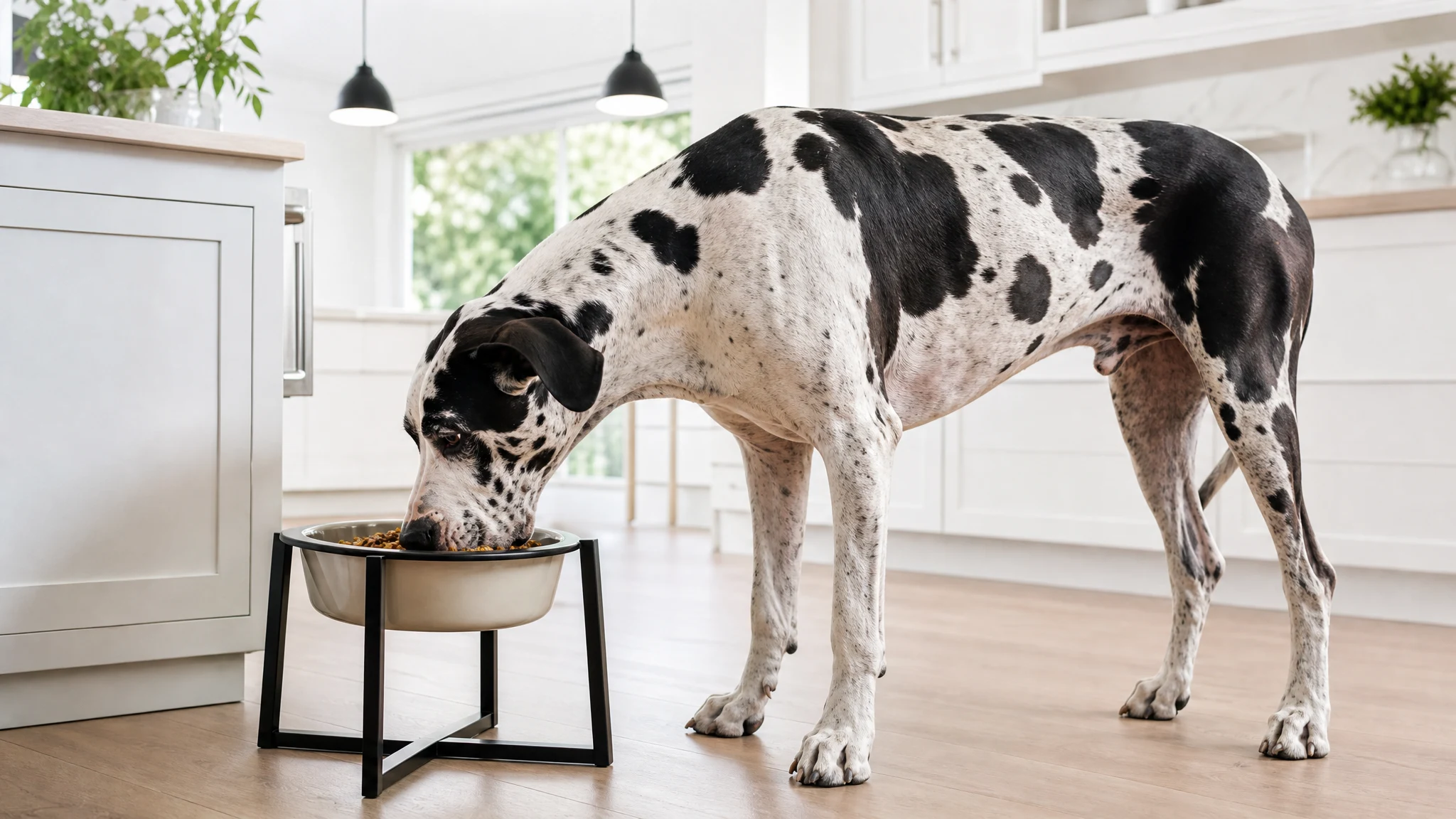
General nutrition information compiled from product labels and published sources, not veterinary advice. Your veterinarian is the right person to choose a diet for your dog, especially one with a health condition.
A Great Dane who spends the week on the couch and one who hikes every weekend do not need the same bowl. The food label gives you a starting point. Your dog's body tells you whether it is right.
This great dane feeding guide walks through a simple method for adjusting portions as activity changes. It uses label data and the breed's own health guidance, not guesswork. For a baseline by age, start with the Great Dane feeding chart by age, then come back here to fine-tune.
What this guide can and cannot do
We compared label data from manufacturer pages. We did not run feeding trials or taste tests, and we did not feed any of these foods to dogs. The numbers below are label guides, meant as starting points only.
No food or portion plan prevents, treats or cures any disease. If your dog has a health condition, a veterinarian decides the amounts, and you should confirm any change with them first.
Materials you will need
- The bag or can your dog eats now, with its feeding guide and calorie statement
- A dry measuring cup (not a scoop or a mug)
- A kitchen scale, if you want to weigh portions in grams or ounces
- A scale that can handle a very large dog, or a vet's clinic scale for periodic weigh-ins
- A notebook or phone note to log weight, portions and activity
- Your vet's contact details for questions
Step 1: Confirm the food fits a Great Dane's life stage
Before adjusting anything, make sure the food suits the dog's age. PetMD says Great Danes are generally treated as adults at about 18 months, and advises keeping puppies on large-breed puppy food until then. PetMD is a secondary source, so ask your vet when your own dog should switch.
Check the nutritional adequacy statement on the label. Whole Dog Journal explains that growth and all-life-stages foods must say whether they cover growth "including" or "except for" large-size dogs, meaning 70 pounds or more as an adult. A Great Dane puppy needs a statement that includes growth of large-size dogs.
For example, Royal Canin's Giant Puppy label and Victor's Hi-Pro Plus Large Breed Puppy label both carry that wording. Nom Nom's Beef Mash label does too. Brand pages are the place to confirm current wording, since labels change.
Step 2: Find the calories in your food, not just the cups
Cups are not a universal unit. Calories per cup vary a lot between foods, so a cup of one food is not a cup of another. Here are label figures from the brands' own pages:
| Food (dry) | Label calories per cup |
|---|---|
| Royal Canin Breed Health Nutrition Great Dane Adult | 390 kcal ME (as fed, calculated) |
| Royal Canin Giant Adult | 427 kcal ME (as fed, calculated) |
| Hill's Science Diet Adult Large Breed Chicken & Barley | 365 kcal |
| Hill's Science Diet Adult 6+ Large Breed | 352 kcal |
| Victor Senior Healthy Weight | 360 kcal |
If you ever switch brands, do not carry the cup measure over. Compare the calories and adjust the cups to match, then follow the transition advice on the new label or from your vet.
Step 3: Start from the label guide for your dog's weight
Use the feeding guide on your food as the baseline. Some pages give fixed amounts, and some do not. Royal Canin's Giant Puppy and Giant Adult pages link to a feeding calculator rather than listing fixed amounts. Hill's pages say to adjust amounts as necessary to maintain optimal weight, and to ask your veterinarian if unsure.
Freshpet's Large Dog Multi-Protein Recipe is one example of a label that gives numbers. It lists 3 1/2 cups per day for dogs 81 pounds and up, plus 3/4 cup for each additional 25 pounds over 80. Freshpet says this can be fed as one meal or split into two.
That is the brand's guide for that recipe, not a rule for every Great Dane. PetMD lists the typical adult range as 110 to 175 pounds, so individual dogs differ a great deal. Write down your baseline amount before changing anything.
Step 4: Describe your dog's activity honestly
Sort the last month into one of three rough groups:
- Low: short leash walks, lots of lounging, an older or recovering dog.
- Moderate: daily walks and regular play with steady routines.
- High: long hikes, frequent running or active outings most days.
Most owners overestimate. A Great Dane who naps most of the day is often in the low group, even with a daily walk. Victor's Senior Healthy Weight page, for example, describes its formula for older, less active dogs or weight reduction, which shows how brands themselves separate these groups.
Step 5: Adjust in small steps, one change at a time
Start at the label baseline for the dog's weight. Then make a small change, such as a slightly smaller or larger portion, based on the activity group. Keep the change modest and change one thing at a time so you can see the effect.
Hold the new amount steady for a few weeks. Weigh your dog on the same scale at the same time of day, and log the result.
Step 6: Check body condition by hand and eye
The scale is only part of the picture. Look at your dog from the side and from above. Run your hands along the ribs.
- You should feel the ribs under a thin layer of padding, without pressing hard.
- You should see a waist from above and a slight tuck behind the ribs from the side.
If ribs are hard to feel, the portion may be too generous for that activity level. If ribs and hips are very prominent, ask your vet before simply adding food. Weight loss in a giant breed can have medical causes.
Step 7: Split meals and mind the timing
The Great Dane Club of America's Health page calls bloat (gastric dilatation-volvulus, or GDV) the number one killer of Great Danes. It says feeding multiple small meals and avoiding vigorous exercise around mealtimes may reduce risk. It also says a prophylactic gastropexy is an option to discuss with a vet.
Royal Canin's Great Dane Adult page makes a similar point. It says the daily ration should be given in at least two meals to help reduce the risks of GDV.
When you raise activity, do not just raise the total. Keep dividing the day's food into smaller meals, and keep hard play away from the bowl, both before and after. Your vet can advise on the schedule for your dog.
Step 8: Re-check when life changes
Review portions whenever something shifts. Common triggers include a new job for the dog, a season with fewer walks, an injury, or a move from adult to senior food. Hill's, for instance, lists its mature adult large breed formula for giant breeds at 5 and older, and the Great Dane's life expectancy is 7 to 10 years according to PetMD. Many Danes reach older-adult needs earlier than owners expect, so talk with your vet about timing.
Tips for success
- Measure every meal. "Eyeballing" a giant bowl can drift by a cup or more.
- Count treats and chews toward the day's food.
- Keep the log. Two or three data points make trends visible.
- Ask the whole household to follow the same plan.
- Read the "guaranteed analysis" as a minimum or maximum, not an average. Some Hill's pages show average dry matter values instead, so compare like with like.
Common mistakes to avoid
- Using cups across brands. As the table shows, calories per cup differ.
- Raising portions for a weekend hike. Adjust for the typical week, not one big day.
- Feeding one big meal. This works against the meal-splitting advice above.
- Exercising right after eating. The GDCA advises avoiding vigorous exercise around mealtimes.
- Cutting puppy food too early or too late. Rapid growth matters. The GDCA describes HOD and panosteitis as painful bone conditions of rapid puppy growth, so follow your vet's lead on puppy diets.
- Chasing a food for a medical problem. Hip dysplasia and dilated cardiomyopathy (DCM) are inherited concerns in the breed, per the GDCA. On DCM, the FDA says no dietary cause has been established and that diet and DCM is a complex issue that may involve multiple factors. Questions about diet and heart health belong with your vet.
What results to expect
If the plan fits, you may see steady body weight, a visible waist, and consistent energy over several weeks. Stools may stay regular too. These are signs to watch for, not promises, and every dog responds differently.
If weight keeps climbing or dropping, or your dog seems lethargic, has a swollen belly, retches without producing anything, or shows other worrying signs, contact a veterinarian right away. Do not wait out a possible bloat emergency.
For a dog with any health condition, confirm amounts with your vet. For product details such as kibble size, which several brand pages do not state, check with the brand directly.
Sources
- Great Dane Club of America, Health page
- PetMD, Great Dane breed page
- FDA CVM, Investigation into Potential Link between Certain Diets and Canine DCM
- Whole Dog Journal, In the Fine Print: Nutritional Adequacy Statements
- Royal Canin, Great Dane Adult product page
- Hill's Pet Nutrition, Adult Large Breed product page
- Victor Pet Food, Senior Healthy Weight product page
- Freshpet, Large Dog Multi-Protein Recipe product page