Great Dane Feeding Guide: Free-Feeding vs Scheduled Meals
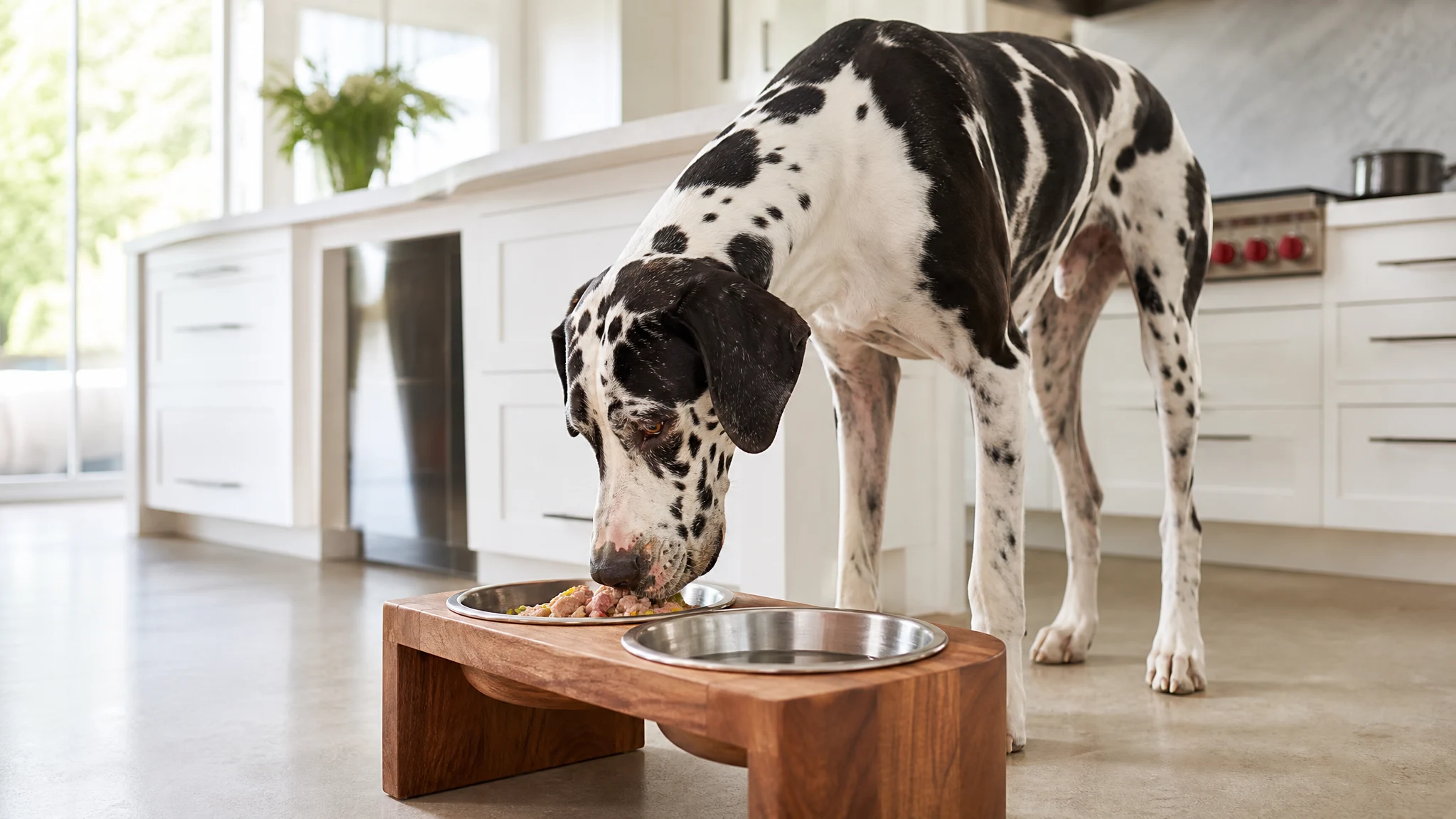
General nutrition information compiled from product labels and published sources, not veterinary advice. Your veterinarian is the right person to choose a diet for your dog, especially one with a health condition.
Should a Great Dane always have a full bowl, or eat at set times? This great dane feeding guide walks through both methods and shows how to move to a schedule if you want one. It also covers the mistakes that trip up owners of giant dogs.
A note on method: we compared published label data and breed club guidance. We did not run feeding trials or taste tests, and we have not fed any of these foods ourselves.
Free-Feeding vs Scheduled Meals: The Short Version
Free-feeding means food is left out all day. Scheduled meals mean you serve a measured portion at set times and pick up the bowl afterward.
For a Great Dane, scheduled meals usually make more sense. The Great Dane Club of America (GDCA) Health page calls bloat, also called GDV (gastric dilatation-volvulus), the number one killer of the breed. It says feeding multiple small meals and avoiding vigorous exercise around mealtimes may reduce risk. A set schedule makes both of those habits easier to follow.
Royal Canin's US page for its Great Dane Adult formula says the daily ration should be given in at least two meals to help reduce the risks of gastric dilation-volvulus. That matches the club's advice.
Free-feeding has a place for some owners, but it has real drawbacks with this breed:
- You cannot see how much each dog eats, so a change in appetite is easy to miss.
- Portions are hard to measure, which matters when a giant puppy is growing fast.
- In a multi-dog home, one dog may eat another's share.
- Meal and exercise timing is hard to control.
No food or feeding method prevents bloat. A veterinarian can talk through risk for your individual dog, including whether a prophylactic gastropexy is an option, as the GDCA mentions.
What You Need
- A complete and balanced food that suits your dog's life stage (see the label notes below).
- A dry measuring cup or a kitchen scale.
- A bowl that is easy to pick up between meals.
- A calendar or phone reminder to keep meal times steady.
- A notebook or app to log portions, appetite and body condition.
- Your veterinarian's contact details, for questions on amounts.
Step-by-Step: Moving to Scheduled Meals
Step 1: Match the food to the life stage
Great Danes grow very fast. PetMD, a secondary source, advises keeping puppies on large-breed puppy food until about 18 months, when it considers a Great Dane an adult. No club or veterinary school source confirmed that exact age, so ask your vet when to switch.
On the bag, look for the AAFCO statement. Whole Dog Journal explains that growth and all-life-stages labels must say whether the food is for growth "including" or "except for" large-size dogs, meaning those 70 pounds or more as adults. A Great Dane needs the "including growth of large-size dogs" wording. Whole Dog Journal is a secondary source, so confirm the wording on the bag itself.
Some examples of label wording, from the brands' own pages:
- Royal Canin Giant Puppy states it is formulated for growth including growth of large size dogs (70 lb. or more as an adult). Its page describes it for giant puppies up to 8 months.
- Victor Hi-Pro Plus Large Breed Puppy carries an all life stages statement that includes growth of large size dogs.
- Hill's Science Diet Puppy Large Breed Chicken & Brown Rice Recipe is described by Hill's for large breed puppies up to 18 months.
Check each brand's own page for current labels before you buy, since formulas change.
Step 2: Find the starting amount on the label
Every feeding guide on a bag is a starting point, not a prescription. Weight, age and activity level all change what a dog needs. Our Great Dane feeding chart by age covers how those pieces fit together.
PetMD lists the average adult Great Dane at 110 to 175 pounds, so many adults land well above the top of a typical chart. Some labels show how their guides scale:
- Freshpet Large Dog Multi-Protein Recipe lists 3 1/2 cups per day for dogs 81 pounds and up, plus 3/4 cup for each additional 25 pounds over 80. Freshpet says this can be fed as one meal or divided into two.
- Hill's Science Diet pages say to adjust amounts as necessary to maintain optimal weight and to ask your veterinarian if you are unsure.
- Royal Canin's Giant Puppy and Giant Adult pages link to a feeding calculator rather than listing fixed amounts.
- Victor says that after age one you should feed to maintain good body condition, using the chart as a guide.
Calories per cup differ a lot between foods. Royal Canin lists 390 kcal ME per cup for Great Dane Adult and 427 for Giant Adult. Freshpet lists 348 for its Large Dog Multi-Protein Recipe. The same cup of two different foods is not the same amount of food, so always use the guide on the bag in your hands.
Step 3: Divide the day's food into at least two meals
Take the daily amount and split it. Two meals is the floor given on the Royal Canin Great Dane Adult label. Growing puppies often eat more meals per day, but the number is not set in the sources we reviewed. Ask your vet how many meals suit your puppy's age.
Pick times you can keep, such as morning and evening. A steady routine helps you notice when your dog's appetite changes.
Step 4: Serve the meal and set a time limit
Put the bowl down in a calm spot. Let your dog eat without hurry or competition. Many owners pick the bowl up after about 20 to 30 minutes. That window is a common habit, not a rule from any of our sources.
If your dog skips a meal, do not add toppers right away. Note it in your log. If skipped meals continue, call your veterinarian.
Step 5: Keep exercise away from mealtimes
The GDCA suggests avoiding vigorous exercise around mealtimes. Keep play, running and rough games well apart from meals. A quiet walk or rest is fine. Your vet can give you more specific timing for your dog.
Step 6: Transition gradually if you switch foods
If you change both the food and the feeding style, change one at a time. Mix a little new food into the old and increase the share over several days. Switching to scheduled meals first, with the same food, keeps it simple. Then you can tell which change affected your dog.
Step 7: Check body condition and adjust
Log weight and body condition every few weeks. If your dog gains or loses weight you did not intend, adjust slightly and tell your vet. For a dog with a health condition, confirm all amounts with your vet before changing them.
If You Still Want to Free-Feed
Some owners of adult dogs prefer a partial approach. If you do, keep these points in mind:
- Measure the day's total into the bowl, so you know the cap.
- Keep dry food only. Wet and fresh foods should not sit out.
- Watch for fast, large gulps after a long gap, which is the opposite of the small-meal advice from the GDCA.
- Do not free-feed a growing puppy. Measured portions help you manage growth.
Talk to your vet before choosing this route for a breed with a known bloat risk.
Common Mistakes to Avoid
- Feeding an adult food to a puppy. Look for the large-size growth wording on the AAFCO statement.
- Copying a chart from a smaller breed. Giant dogs often sit beyond the range of standard charts.
- Counting only the bowl. Treats, chews and table scraps add calories.
- Feeding one large meal. This works against the small-meal advice from the GDCA.
- Exercising right after eating. Keep meals and vigorous play apart.
- Chasing a food for health claims. The FDA has said no dietary cause has been established for canine DCM, and its latest update on that page is dated December 23, 2022. The GDCA says DCM is suspected to be inherited in Great Danes. Ask your vet about heart screening and diet.
- Using a food as treatment. No food treats or cures hip dysplasia, allergies, DCM or bloat. Only a veterinarian can prescribe a therapeutic diet.
Tips for Success
- Use the same measuring cup every time. Cups vary in size.
- Weigh the kibble now and then to check your scoop.
- Feed at the same times, including weekends.
- Keep a note of the product name and lot on the bag in case you have questions later.
- Watch fast growth. The GDCA notes that HOD and panosteitis are painful bone conditions of rapid puppy growth, and that HOD can be deadly. Call your vet if your puppy seems lame or unwell.
What to Expect
Many owners find that scheduled meals make appetite, weight and stool easier to track. Your dog may settle into a predictable routine within a few weeks. Results vary by dog.
A set schedule may also make it easier to follow the GDCA's advice on small meals and mealtime exercise, which may reduce bloat risk. It cannot remove that risk. Learn the signs of bloat and ask your vet for an emergency plan.
Because a Great Dane's life expectancy is 7 to 10 years according to PetMD, steady, measured feeding is one of the simpler ways to support lifelong health. Your veterinarian remains the right person to set amounts for your individual dog.
Sources
- Great Dane Club of America, Health page
- PetMD, Great Dane breed page
- Whole Dog Journal, In the Fine Print: Nutritional Adequacy Statements
- FDA CVM, Investigation into Potential Link between Certain Diets and Canine DCM
- Royal Canin US, Great Dane Adult product page
- Freshpet, Large Dog Multi-Protein Recipe product page