Great Dane Puppy Feeding Chart: Switching to Adult Portions
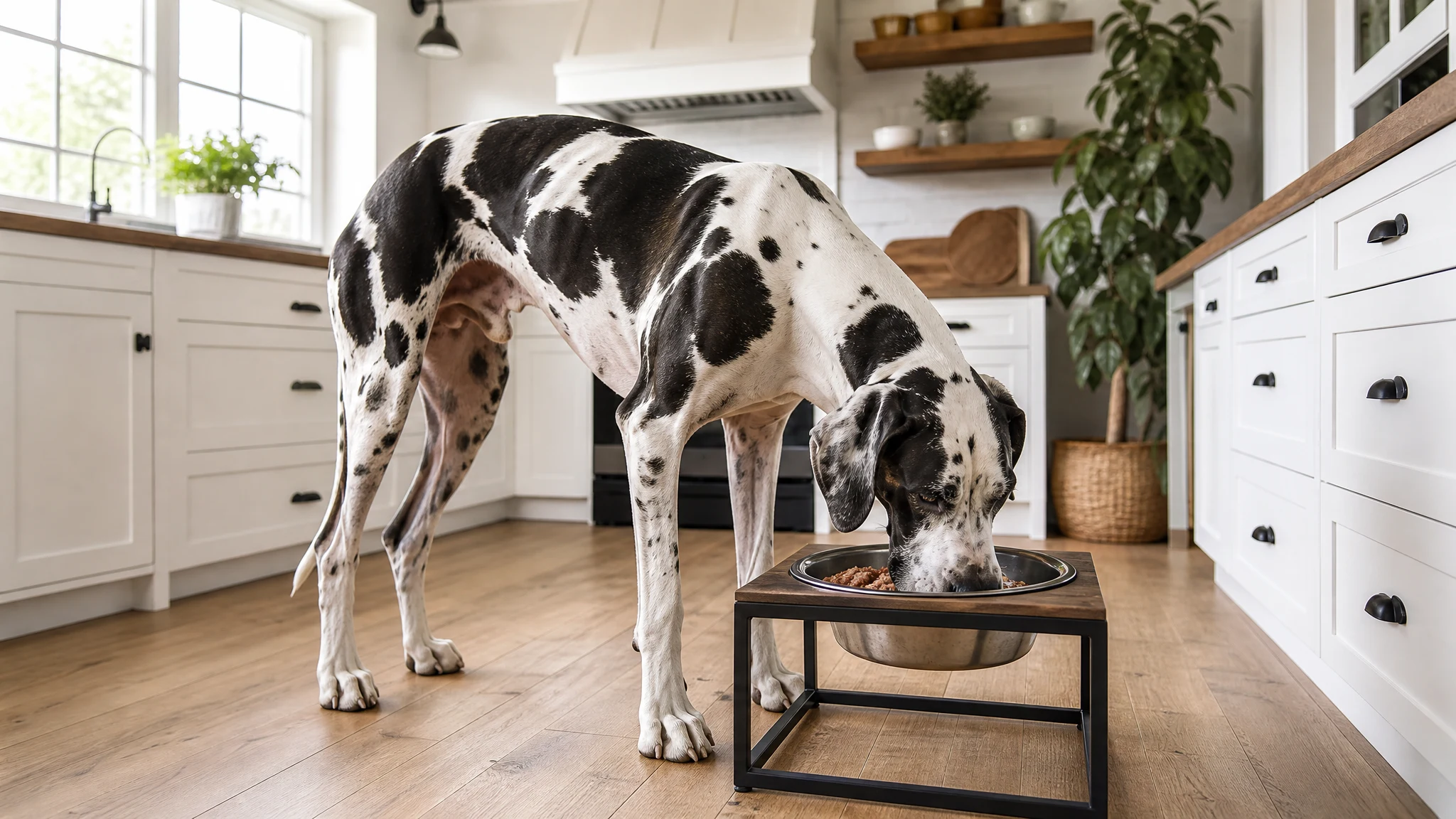
General nutrition information compiled from product labels and published sources, not veterinary advice. Your veterinarian is the right person to choose a diet for your dog, especially one with a health condition.
A Great Dane puppy feeding chart works well for months. Then the dog nears adult size, growth slows, and the numbers on the bag stop fitting. This guide walks through the switch from puppy food to adult food and from puppy portions to adult portions, one step at a time.
We compared label data from the brands' own pages. We did not run feeding trials or taste tests, and we did not feed any of these foods ourselves. Treat everything here as a starting point to talk over with your veterinarian.
When Does a Great Dane Switch to Adult Food?
PetMD, a secondary source, describes a Great Dane as an adult at about 18 months. It advises keeping puppies on large-breed puppy food until then. PetMD lists the average adult weight as 110 to 175 pounds, with a height of 28 to 32 inches.
Brands set their own age ranges, and they differ:
- Royal Canin Giant Puppy is labeled for giant-breed puppies up to 8 months.
- Hill's Science Diet Puppy Large Breed is labeled for growth up to 18 months.
- Royal Canin Breed Health Nutrition Great Dane Adult is labeled for purebred Great Danes 24 months and older.
These ranges overlap and do not agree. Your dog's growth, body condition and your veterinarian's advice matter more than one date on a bag. If your dog is between ages, ask your vet which food fits.
What You Need Before You Start
- The current puppy food and the new adult food, with enough of both for about two weeks of mixing.
- A dry measuring cup, or a kitchen scale if your vet suggests weighing portions.
- A notebook or phone note for weight, meal sizes and stool quality.
- Access to a scale that can handle a giant dog. Your vet's office can often weigh your dog.
- The feeding guide printed on each bag, or on the brand's own page.
- Your veterinarian's number, especially if your dog has a health condition.
Step 1: Check That the New Food Suits a Great Dane
Start with the nutritional adequacy statement on the bag. Whole Dog Journal, a secondary source, explains that AAFCO growth and all-life-stages labels must say whether the food is for growth "including" or "except for" large-size dogs, meaning 70 pounds or more as an adult. A Great Dane puppy needs a food that says "including growth of large-size dogs."
Once your dog is an adult, the statement you want is for maintenance, or for all life stages. Some examples from the brands' own pages:
- Royal Canin Giant Adult states it is formulated for AAFCO maintenance levels. Its first five ingredients are chicken by-product meal, brewers rice, chicken fat, brown rice and corn protein meal. The label lists 26% minimum protein, 18% minimum fat and 427 kcal ME per cup (calculated, as fed).
- Royal Canin Breed Health Nutrition Great Dane Adult lists 21% minimum protein, 23% minimum fat and 390 kcal ME per cup. The brand describes the kibble as large and textured, designed for the Great Dane's large jaw.
- Hill's Science Diet Adult Large Breed Chicken & Barley lists 365 kcal per cup. Hill's shows average dry matter protein of 23.8% and fat of 15%. Those are averages, not guaranteed minimums.
Notice that calories per cup vary by about 60 or more between these foods. A cup of one food is not a cup of another. That is why portions must be recalculated, not copied over.
Step 2: Open the Feeding Guide and Treat It as a Starting Point
Every feeding guide on a bag is a starting estimate. The Hill's pages say to adjust amounts to maintain optimal weight and to ask your veterinarian if you are unsure. Nom Nom says its recommendations are only a guide and may vary with age, weight and activity level. The Royal Canin Giant pages link to a feeding calculator instead of fixed amounts.
Use three inputs when you read any guide:
- Current weight. Weigh your dog, not your guess of your dog.
- Age. A dog at 14 months is still finishing growth. A dog at 24 months is usually finished.
- Activity level. A dog that hikes daily may need more than a sofa-loving dog of the same weight.
For a broader age-by-age reference, see our Great Dane feeding chart by age. Then check it against the bag you are actually buying.
Step 3: Keep Meals Split
The Great Dane Club of America (GDCA) health page calls bloat, or gastric dilatation-volvulus (GDV), the number one killer of Great Danes. It says feeding multiple small meals and avoiding vigorous exercise around mealtimes may reduce risk. It also says a prophylactic gastropexy is an option to discuss with a vet.
Royal Canin's Great Dane Adult page says the daily ration should be given in at least two meals to help reduce the risk of gastric dilation-volvulus. Freshpet and Hill's pages also note that daily amounts can be divided into two meals.
So when you move to adult portions, do not collapse everything into one big meal. Keep at least two meals a day, and ask your vet how many is right for your dog.
Step 4: Mix the Foods Gradually
The brands' pages in our research did not give a single mixing schedule, so ask your veterinarian for one. A common approach is to start with mostly the old food and a small share of the new, then shift the balance over a week or two. Slow is fine for a giant dog with a big digestive system.
- Begin with the old food as most of the bowl and a small amount of the new food mixed in.
- Every few days, add a little more new food and a little less old food.
- Watch stools, appetite and energy at each change.
- If stools turn loose or your dog stops eating, hold at the current mix and call your vet.
- Finish on 100% new food only when the previous stage went smoothly.
Measure total daily calories, not just cups, at each stage. A change in food shifts calories even if the cup size stays the same.
Step 5: Recalculate Daily Portions for the New Food
Take the current daily intake in calories, if the puppy food label gives kcal per cup. For example, Royal Canin Giant Puppy lists 338 kcal ME per cup, while Royal Canin Giant Adult lists 427. The same number of cups of the adult food would deliver noticeably more energy.
Then compare with the new bag's guide for your dog's weight. Start from the label guide and adjust from there. If the two numbers point in different directions, your vet can help you choose.
Fresh and wet foods work differently. The Hill's canned adult entree lists 369 kcal per 13 ounce can, not per cup. Freshpet's Large Dog Multi-Protein Recipe lists 348 kcal per cup, with a guide of 3 1/2 cups a day for 81 pounds and over, plus 3/4 cup per additional 25 pounds over 80. Check the brand's page for the current guide before you rely on those figures.
Step 6: Track Weight and Body Condition
For the next several weeks, weigh your dog on a regular schedule and note the number. Feel the ribs and look at the waist from above. A healthy dog usually has ribs you can feel under a thin layer of padding. Your vet can show you how to score body condition.
If weight rises faster than expected, trim the portion slightly. If your dog looks thin, increase it slightly. Make small changes and re-check, rather than big jumps.
Tips and Common Mistakes
- Switching too early. Moving to adult food before about 18 months may skip the large-breed growth formulation PetMD advises. Confirm timing with your vet.
- Switching all at once. A sudden change can upset the stomach. Mix gradually.
- Copying cups, not calories. Calorie density differs between foods, as the figures above show.
- Feeding one large meal. This works against the GDCA's advice on multiple small meals.
- Exercise right after meals. The GDCA says to avoid vigorous exercise around mealtimes.
- Adding supplements on your own. Do not add calcium or other supplements without your vet. Growth minerals matter in big puppies, and we do not give supplement amounts here.
- Trusting marketing words. "Natural," "premium" and similar words are not nutritional claims. Read the adequacy statement, ingredient list and calories.
- Leaning on grain-free labels. The FDA's investigation into diets and canine dilated cardiomyopathy (DCM) says no dietary cause has been established. Its last update was dated December 23, 2022. The GDCA says DCM is suspected to be inherited in the breed. Ask your vet what is right for your dog.
Dogs With Health Conditions
If your Great Dane has a health condition, such as a heart, joint or digestive problem, confirm amounts and food choice with your veterinarian before you switch. The GDCA health page lists hip dysplasia, DCM, and the painful growth conditions HOD and panosteitis among its concerns. No food prevents, treats or cures any of these. Prescription diets are something only a veterinarian prescribes, and your vet decides what suits an individual dog.
What to Expect
If the switch goes smoothly, you may see steady stools, a consistent appetite and a stable weight within a few weeks. Some dogs may take longer to settle. Growth does not stop on one date, so your dog may still gain some weight and fill out after the switch.
These results are not promised. Every Great Dane is different, and a large, fast-growing breed is worth watching closely. If your dog has ongoing vomiting, diarrhea, bloating, a swollen belly or refuses food, call your veterinarian right away.
Quick Summary
- Confirm timing with your vet. PetMD suggests about 18 months.
- Check the adequacy statement and calories per cup.
- Use the label guide as a starting point.
- Keep at least two meals a day.
- Mix the foods gradually.
- Recalculate portions for the new food.
- Weigh and check body condition regularly.
Sources
- Great Dane Club of America, Health page
- PetMD, Great Dane breed page
- Whole Dog Journal, In the Fine Print: Nutritional Adequacy Statements
- FDA CVM, Investigation into Potential Link between Certain Diets and Canine DCM
- Royal Canin, Great Dane Adult
- Royal Canin, Giant Puppy
- Royal Canin, Giant Adult
- Hill's Pet Nutrition, Adult Large Breed
- Freshpet, Large Dog Multi-Protein Recipe