Great Dane Healthy Weight: Body Condition Scoring Explained
General nutrition information compiled from product labels and published sources, not veterinary advice. Your veterinarian is the right person to choose a diet for your dog, especially one with a health condition.
A scale number alone does not tell you much about a giant dog. A lean 175 pound Dane and a soft 175 pound Dane can weigh the same and look very different. Body condition scoring fills that gap. It is a hands-on check of ribs, waist and belly that you can do at home in a few minutes.
This guide walks through the check step by step. It also covers what a great dane healthy weight tends to look like, the mistakes owners often make, and when to bring in your veterinarian.
Why weight matters more in a giant breed
PetMD lists adult Great Danes at an average of 110 to 175 pounds and 28 to 32 inches tall. It also gives a life expectancy of 7 to 10 years. That is a wide weight range, so a single "correct" number does not exist. Frame, sex, age and build all change what is right for one dog.
The Great Dane Club of America (GDCA) health page names bloat, also called gastric dilatation-volvulus (GDV), as the number one killer of the breed. It also describes hip dysplasia as inherited, with multi-factorial expression. Body condition scoring cannot predict or prevent either one. What it does is give you a steady way to notice change early, so you can talk it over with your veterinarian.
What you need
- Your hands. Clean and dry, with the dog standing calmly.
- A scale you can use repeatedly. Many clinics let owners of giant dogs walk in and weigh without an appointment. Call first and ask.
- A notebook or phone notes for a simple log.
- A phone camera for side and top-down photos.
- The food label and a standard measuring cup, so you know what the dog actually eats.
- A body condition chart from your veterinarian. Clinics commonly use a 9-point scale, but ask which chart they prefer so your scores match theirs.
Step-by-step: scoring your Great Dane
Step 1: Set up the same way every time
Pick a flat, non-slip floor. Have your dog stand square on all four legs with the head in a natural position. Do the check before a meal, not after, because a full stomach can change how the belly looks. This matters even more for a breed with bloat concerns. The GDCA says avoiding vigorous exercise around mealtimes may reduce risk, so a calm check before feeding fits well.
Step 2: Feel the ribs
Rest your palms flat on both sides of the chest and press lightly. On a dog in healthy condition, you can usually feel the ribs under a thin layer of tissue, without having to dig. If the ribs are sharply visible from across the room, the dog may be too thin. If you have to press hard to find them, the dog may be carrying extra.
Great Danes have a deep chest, so a little rib definition can look dramatic. Judge by touch, not just by sight.
Step 3: Look from the side
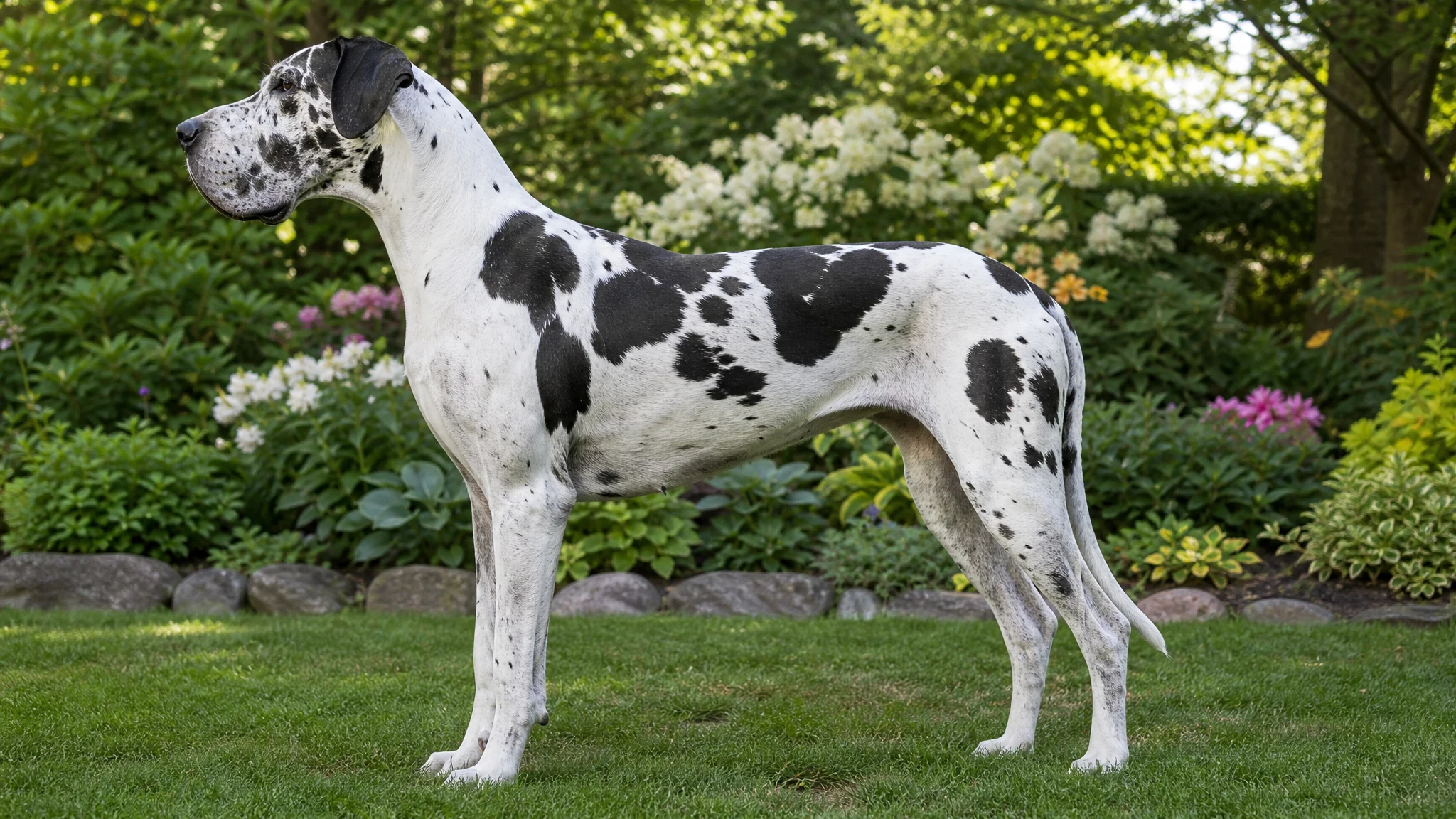
Stand level with your dog and look at the belly line. In a typical healthy outline, the belly rises from the bottom of the chest toward the hind legs. This is often called the abdominal tuck. A belly that hangs level with the chest, or sags below it, suggests extra weight. An extreme tuck with bones showing suggests too little.
Step 4: Look from above
Stand over your dog and look down the back. You should see a gentle waist behind the ribs, where the body narrows before the hips. A straight, tube-like shape or a bulge at the sides is a sign to look closer. A very pronounced hourglass can mean the dog is lean to the point of concern.
Step 5: Check the hips, spine and base of the tail
Run your hand along the spine and over the hip bones. You should feel them without them jutting out sharply. Thick, padded tissue over the spine and tail base often points toward extra weight. Prominent, sharp bones with little covering point the other way.
Step 6: Assign a score and write it down
Compare what you found with the chart. On a 9-point scale, the middle numbers are generally the ideal zone, lower numbers mean too thin and higher numbers mean overweight. Your veterinarian can tell you the exact target range for your dog. Log the score, the date, the weight and the photos.
Step 7: Repeat on a schedule
Check every few weeks in an adult and more often in a growing puppy. Trends matter more than any single day. If the score creeps up or down across two or three checks, that is your cue to call the clinic.
Puppies need extra care
Great Danes grow very fast. PetMD, quoting the GDCA, advises large-breed puppy food, and it says to keep puppies on it until about 18 months, when it considers them adult. No club or veterinary school source confirmed that exact age, so ask your veterinarian when to switch.
The GDCA health page describes hypertrophic osteodystrophy (HOD) and panosteitis as painful bone conditions of rapid puppy growth. It says HOD is the more serious and can be deadly. Because of this, a chubby Dane puppy is not a goal. Aim for a trim, steady puppy, and have your veterinarian review the growth curve at each visit.
Check the food label too. Whole Dog Journal explains that AAFCO growth and all-life-stages statements must say whether the food is for growth "including" or "except for" large-size dogs, meaning 70 pounds or more as an adult. For a Great Dane puppy, look for the wording "including growth of large size dogs." For example, Royal Canin's Giant Puppy label carries that statement, and so does the Victor Hi-Pro Plus Large Breed Puppy label. Neither is a recommendation. They show what the wording looks like on a real label.
Using food amounts as a starting point
Once you have a score, you can look at what goes in the bowl. Feeding guides on bags are starting points, not prescriptions. Hill's Science Diet pages, for example, say to adjust amounts as necessary to maintain optimal weight and to ask your veterinarian if you are unsure. Victor says to feed to maintain good body condition after age one, using the chart as a guide.
Calorie density varies a lot between foods. Per the brands' own pages, the Royal Canin Great Dane Adult lists 390 kcal ME per cup, while its Giant Adult lists 427 kcal ME per cup. Hill's Science Diet Adult Large Breed lists 365 kcal per cup. If you switch foods, the same cup can mean quite different calories, so recheck the body condition score a few weeks later. Make the change gradually and ask your veterinarian how.
When we compare foods on this site, we compare label data such as AAFCO statements, ingredients and calories. We have not run feeding trials or taste tests. The label cannot tell you what is right for your individual dog. For more on how diet factors fit together, see Great Dane nutrition and the diet factors that matter.
Meal timing and bloat
The GDCA says feeding multiple small meals may reduce bloat risk, and that a prophylactic gastropexy is an option to discuss with a veterinarian. Royal Canin's Great Dane Adult page also says the daily ration should be given in at least two meals. If your dog needs to gain or lose weight, split the adjusted amount across meals rather than serving it all at once. No feeding plan removes the risk completely, so learn the emergency signs from your veterinarian and keep the after-hours clinic number handy.
Tips for accurate scoring
- Score in the same spot, same time of day, same posture.
- Take a photo from above and from the side each time. Photos catch gradual change that your eyes miss because you see your dog daily.
- Use a measuring cup, not a scoop or a coffee mug, for every meal.
- Count treats and chews as food. In a giant breed, they add up.
- Let a second person score the dog independently, then compare notes.
- Bring your log to vet visits. It gives your veterinarian more to work with than a single weigh-in.
Common mistakes to avoid
- Going by weight alone. The 110 to 175 pound range is wide. Condition tells you more than the number.
- Judging a puppy by adult standards. Growth is rapid, and the plan should come from your veterinarian.
- Cutting food sharply. Big changes to a giant dog's diet are best made with veterinary guidance, not guesswork.
- Scoring right after a meal or hard exercise. A full belly distorts the outline, and exercise near mealtimes is something the GDCA flags for bloat risk.
- Assuming a coat hides nothing. Great Danes have short coats, but loose skin and muscle can still make the ribs and hips look different from how they feel.
- Treating a food as a fix. No food prevents, treats or cures hip dysplasia, DCM, bloat or any other condition. Your veterinarian decides what is right for an individual dog.
- Ignoring sudden change. Fast weight loss, a swollen belly or a drop in appetite calls for a veterinary visit, not a wait-and-see approach.
What results to expect
With regular scoring, many owners find it easier to spot small shifts in their dog's condition before they become large ones. Over a few months, a written log can help you and your veterinarian see whether a food, portion or routine change seems to be working. Results vary by dog, and a steady, gradual change is usually easier to judge than a fast one.
Weight is also only one piece of heart and joint health. The GDCA notes that dilated cardiomyopathy (DCM) is suspected to be inherited in the breed, and that an echocardiogram confirms it. A normal result does not guarantee the disease will not develop later. The FDA's investigation into diet and DCM, last updated December 23, 2022, says no dietary cause has been established. The agency does not plan more public updates until there is meaningful new scientific information. Keep your dog's regular checkups, whatever the scale says.
When to call your veterinarian
- Your dog scores in the thin or overweight range on two or more checks in a row.
- Weight changes without a change in food or exercise.
- Your puppy is growing unusually fast, or seems painful or reluctant to move.
- You are thinking about changing foods, portions or meal frequency.
- Your dog's belly looks swollen or tight, or your dog is restless and retching without producing anything. Treat this as an emergency.
Bring your log, your photos and the current food label. For prescription diets or any weight-management plan, your veterinarian is the one who decides.
Sources
- Great Dane Club of America, Health page
- PetMD, Great Dane breed page
- Whole Dog Journal, In the Fine Print: Nutritional Adequacy Statements
- FDA CVM, Investigation into Potential Link between Certain Diets and Canine DCM
- Royal Canin, Great Dane Adult product page
- Hill's Pet Nutrition, Science Diet Adult Large Breed product page
- Victor Pet Food, Hi-Pro Plus Large Breed Puppy product page