Great Dane Healthy Weight: Calorie Needs by Age
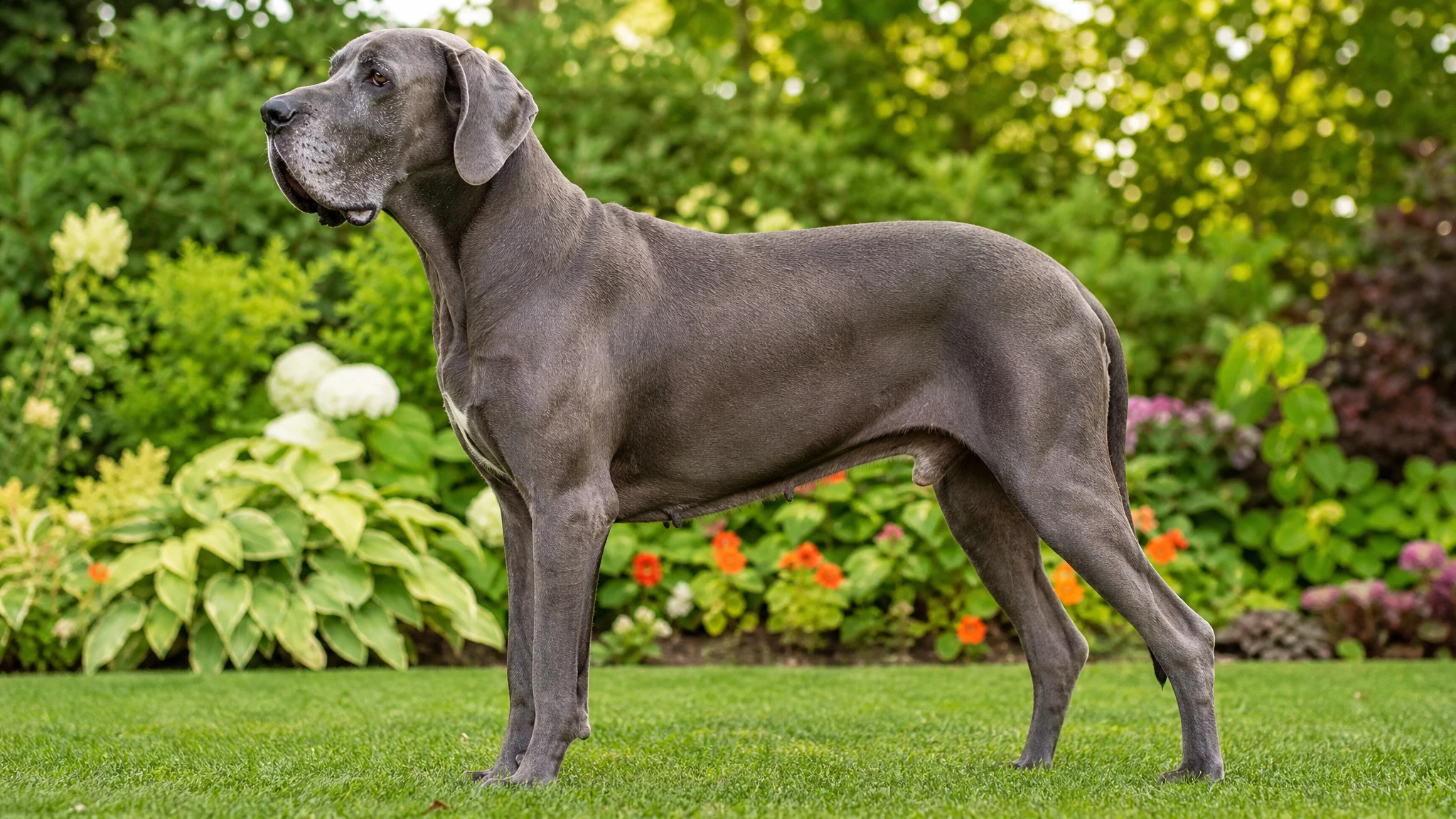
General nutrition information compiled from product labels and published sources, not veterinary advice. Your veterinarian is the right person to choose a diet for your dog, especially one with a health condition.
Calorie needs in a Great Dane change a lot from puppyhood to the senior years. A fixed number on a chart can mislead you, because dogs of the same age differ in frame, activity and metabolism. This guide shows you how to build a great dane healthy weight plan from the food label, then adjust it with your veterinarian.
We will not hand you a daily calorie target for each age. No source we trust gives one that fits every Dane. What we can do is show you how to read label data, turn it into a starting amount, and track the result.
How we compared the food data
We compared label data only: AAFCO statements, calories per cup, and the brand's own feeding notes. We did not run feeding trials or taste tests. Treat every number below as a starting point to discuss with your veterinarian.
What you need
- The bag or can of your dog's current food, with the AAFCO statement and calorie content (kcal per cup)
- A standard measuring cup, or a kitchen scale if your vet suggests weighing food
- A way to weigh your dog regularly. Many clinics let you stop in for a weigh-in.
- A notebook or phone note for dates, weights and amounts fed
- Your veterinarian's input on body condition
Step 1: Know the size you are planning for
PetMD, a secondary source, lists the average adult Great Dane at 110 to 175 pounds and 28 to 32 inches tall. It also gives a typical life expectancy of 7 to 10 years. That wide weight range is why one dog's healthy weight is not another's. Your dog's frame, not the average, sets the goal.
The Great Dane Club of America (GDCA) is the breed's national club. Its health page is a good place to learn what the breed faces, and we cite it below.
Step 2: Match the food to the life stage
Calories only make sense when the food suits the age. PetMD advises keeping Great Dane puppies on large-breed puppy food until about 18 months. It notes that Danes grow very fast. No club or veterinary school source confirmed that 18-month figure for us, so ask your veterinarian when to switch.
For puppies, check the AAFCO statement. Whole Dog Journal, a secondary source, explains that growth and all-life-stages labels must say whether the food is for growth "including" or "except for" large-size dogs (70 pounds or more as an adult). A Great Dane needs wording that says "including growth of large-size dogs."
Here is how some label statements read, from the brands' own pages:
- Royal Canin Giant Puppy states it meets AAFCO profiles for growth including growth of large size dogs, and it is listed for giant puppies up to 8 months.
- Victor Hi-Pro Plus Large Breed Puppy states it meets AAFCO profiles for all life stages including growth of large size dogs.
- Hill's Science Diet Puppy Large Breed lists large breed puppies up to 18 months.
Why does this matter for weight? Because the PetMD page, quoting the GDCA, points to rapid growth as a concern. The GDCA health page describes HOD and panosteitis as painful bone conditions of rapid puppy growth, and calls HOD the more serious. A veterinarian decides how fast an individual puppy should grow. Do not push calories to speed growth.
Step 3: Find the calories on the label
Look for "kcal ME per cup" or "kcal per cup" on the bag or the brand's product page. Foods differ a lot. Here are examples from the brands' own pages:
| Food | Stage on label | Calories on label |
|---|---|---|
| Royal Canin Giant Puppy | Giant puppy, up to 8 months | 338 kcal ME per cup |
| Hill's Science Diet Puppy Large Breed | Large breed puppy | 387 kcal per cup |
| Victor Hi-Pro Plus Large Breed Puppy | All life stages, incl. large-size growth | 365 kcal per cup |
| Royal Canin Great Dane Adult | Purebred Great Danes 24 months and older | 390 kcal ME per cup |
| Royal Canin Giant Adult | Adult giant breed | 427 kcal ME per cup |
| Hill's Science Diet Adult Large Breed | Large breed adult | 365 kcal per cup |
| Hill's Science Diet Adult 6+ Large Breed | Mature adult | 352 kcal per cup |
Notice the spread. The same cup of food can differ by almost 90 calories between two adult formulas on this list. If you switch brands and keep the same cup count, your dog's intake changes. Always recalculate.
The Royal Canin Giant Puppy and Giant Adult pages link to a feeding calculator instead of fixed amounts, so use the brand's tool for those. Hill's pages say to adjust amounts as needed to maintain optimal weight, and to ask your veterinarian if you are unsure.
Step 4: Start from the label guide, then do the math
The label's feeding guide is your starting point, not a prescription. Find your dog's current weight on the chart and note the daily amount.
Then multiply to see the calories. As arithmetic only: if a guide said 5 cups a day of a 390 kcal per cup food, that is 1,950 kcal. This is an illustration of the math, not a recommended amount.
Write down the daily total in kcal. That number lets you compare foods fairly later, and it helps your veterinarian advise you.
Step 5: Split the daily amount into meals
Bloat, also called GDV (gastric dilatation-volvulus), is a major concern in the breed. The GDCA health page calls it the number one killer of Great Danes. It says feeding multiple small meals and avoiding vigorous exercise around mealtimes may reduce risk. It also notes that a prophylactic gastropexy is an option to discuss with a vet.
Royal Canin's Great Dane Adult page also says the daily ration should be given in at least two meals to help reduce the risks of gastric dilation-volvulus. So divide the daily total into at least two meals, and ask your veterinarian what schedule suits your dog.
Some Freshpet recipes say they can be fed as one meal or split into two. For a Great Dane, discuss that choice with your veterinarian before using the single-meal option.
Step 6: Track weight and body shape
- Weigh your dog on a regular schedule, such as every two weeks for a growing puppy and monthly for an adult. Ask your veterinarian what schedule fits.
- Record the weight, the date and the daily amount fed.
- Ask your veterinarian to show you how to judge body condition by sight and touch. Weight alone does not tell you whether a Dane is lean, ideal or overweight.
- Count everything: treats, chews, and food used for training all add calories.
Step 7: Adjust by age
Puppy (to about 18 months)
Stay on a large-breed or giant-breed puppy food with the "including growth of large-size dogs" wording. Use the label guide, weigh often, and let your veterinarian say whether growth is on track. Your aim is steady growth, not the fastest growth.
Young adult (about 18 months to the senior years)
Royal Canin lists its Great Dane Adult formula for purebred Danes 24 months and older. Hill's lists its Adult Large Breed food for large breeds 1 to 5 years and giant breeds 1 to 4 years. Label ages differ by brand, so your veterinarian's call on timing matters most. When you switch foods, recalculate calories using the new label.
Mature and senior
Hill's lists its Adult 6+ Large Breed food for giant breeds 5 and older. With a typical life expectancy of 7 to 10 years according to PetMD, many Danes reach this stage early. Activity often drops, so watch the scale and body shape. Ask your veterinarian before changing amounts, because weight loss in an older dog can also signal a health problem.
For a wider look at the factors behind these choices, see our guide to Great Dane nutrition and the diet factors that matter.
Tips
- Change amounts in small steps and wait a couple of weeks before judging the result.
- Switch foods gradually, and recheck the kcal per cup each time.
- Use the same cup and the same scale each time so your records stay comparable.
- Keep exercise gentle around mealtimes, as the GDCA suggests.
Common mistakes to avoid
- Feeding a puppy to grow faster. The GDCA ties rapid growth to painful bone conditions.
- Using an all-life-stages or growth food without the large-size wording. Check the AAFCO statement.
- Keeping the same cups after a brand change. Calories per cup vary widely.
- Forgetting treats. They count toward the daily total.
- One big meal a day. The GDCA recommends multiple small meals for bloat risk.
- Choosing a food because of a diet trend. The FDA said in its DCM investigation that no dietary cause has been established, and that the issue is complex and may involve multiple factors. Its last public update was December 23, 2022. The GDCA says DCM is suspected to be inherited in the breed, so ask your veterinarian about heart screening.
What results to expect
If you track amounts and adjust gradually, you may see a steadier growth curve in a puppy and a more stable weight in an adult. Your veterinarian may find it easier to spot changes early. Results vary by dog.
No food or feeding plan prevents, treats or cures hip dysplasia, DCM, bloat or any other condition. The GDCA describes hip dysplasia as inherited with multi-factorial expression. A healthy weight is one part of the picture, and your veterinarian decides what is right for an individual dog.
Sources
- Great Dane Club of America, Health page
- PetMD, Great Dane breed page
- Whole Dog Journal, In the Fine Print: Nutritional Adequacy Statements
- FDA CVM, Investigation into Potential Link between Certain Diets and Canine DCM
- Royal Canin, Great Dane Adult product page
- Royal Canin, Giant Puppy product page
- Royal Canin, Giant Adult product page
- Hill's Pet Nutrition, Adult Large Breed product page
- Hill's Pet Nutrition, Adult 6+ Large Breed product page
- Hill's Pet Nutrition, Puppy Large Breed product page
- Victor Pet Food, Hi-Pro Plus Large Breed Puppy product page